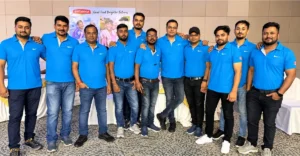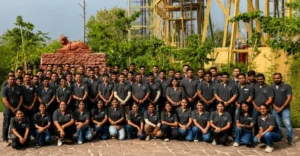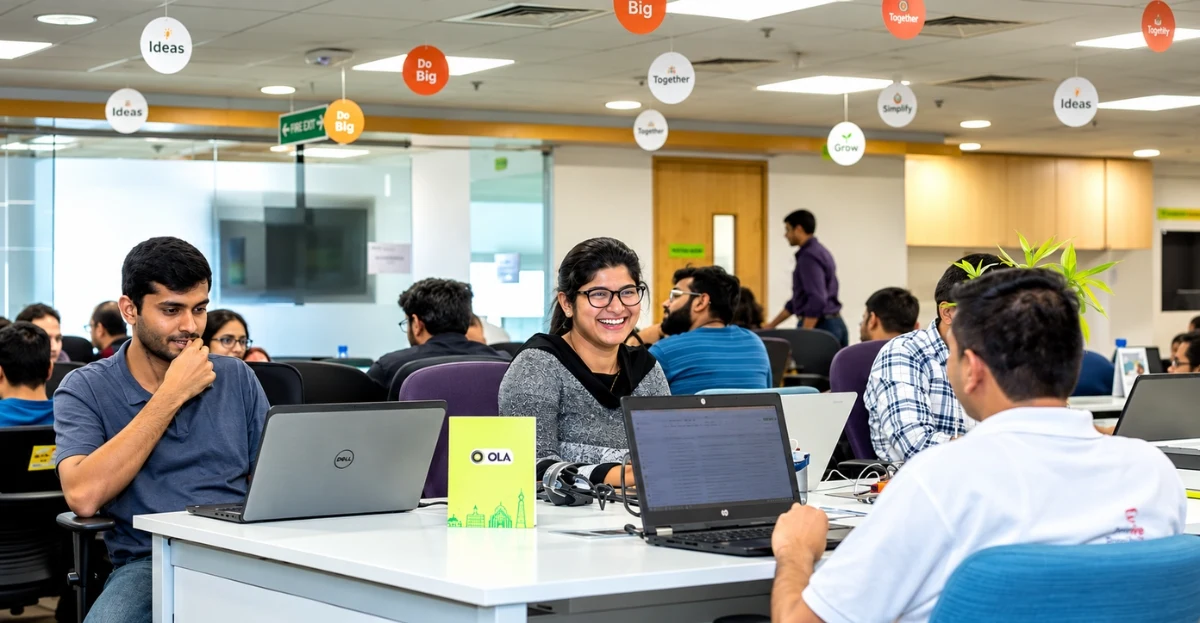
Image Source: https://www.glassdoor.co.in/Photos/Ola-Office-Photos-E587383.htm
Ola Electric went from breaking ground on an empty 500-acre plot in Krishnagiri to running one of India’s largest two-wheeler factories in about a year. That kind of speed changes how a company has to think about culture. You can’t onboard, train, and align thousands of shop-floor workers the way you’d build a 40-person tech team. Ola Electric’s culture, as it’s actually practiced inside the Futurefactory, is a case study in what happens when a startup tries to industrialize its mission before it’s finished industrializing its processes.
This isn’t a puff piece. Ola Electric has real wins on the factory floor and real, well-reported problems in its corporate ranks. Both matter if you’re trying to build culture while scaling fast.
The Manufacturing Problem Nobody Talks About
Most culture articles about fast-growing startups are really about software companies – free lunches, flat hierarchies, Slack channels. Manufacturing is a different animal. You’re not managing knowledge workers who can work from anywhere. You’re managing shift patterns, safety protocols, and a production line where one untrained worker can slow down everyone behind them.
Ola Electric’s Futurefactory in Pochampalli, Tamil Nadu, was built to eventually produce more than 10 million two-wheelers a year, running welding, painting, and battery assembly lines alongside thousands of automated robots. Hiring for that kind of operation isn’t like hiring engineers. You need people who can learn a repetitive, precision task fast, stick with it through long shifts, and do it safely next to machinery that doesn’t pause for mistakes.
That’s the actual problem Ola Electric had to solve. Culture, here, isn’t a perks question. It’s a training-and-retention question at industrial scale.
What Ola Electric Actually Built on the Shop Floor
The most-cited piece of Ola Electric’s culture strategy is its decision to staff the Futurefactory’s production floor almost entirely with women – over 10,000 at full capacity, according to Ola Electric’s own description of the plant. Most of the hires came straight from local polytechnics and diploma colleges near Krishnagiri, many as first-generation working women with no prior factory experience.
The company built its training around that reality instead of around instructions to catch up. New hires go through structured upskilling in welding, sub-assembly, and battery handling before they’re ever put on a live line, and the company has said publicly that the arrangement led to fewer absences and workers picking up multiple skill sets faster than expected. Whether you read that as smart operational design or as a talking point in an investor deck probably depends on how much you trust self-reported numbers from any company. Either way, the underlying idea holds up: if you’re scaling a factory faster than the local labor market has trained workers for your exact process, you have to build the training system yourself, and you have to build it before day one, not after the line is already running behind.
This is the same instinct that shows up in how Britannia keeps its factory and corporate teams engaged – treat the shop floor as a distinct culture problem with its own rules, not a smaller version of the head-office culture deck.
The Mission-First Leadership Style
Culture at Ola Electric doesn’t come from a values poster. It comes almost entirely from founder Bhavish Aggarwal, and he’s been unusually direct about what he expects. When employees described the internal environment as a “hostile work culture” in media reports, Aggarwal didn’t walk it back. He told reporters the company is “a very hardworking company” with “a mission,” adding that Ola isn’t built for people who want “a nice time,” according to YourStory’s coverage of the exchange.
That’s an unusually blunt thing for a CEO to say on the record. It’s also, in its own way, a form of culture-building – it filters for who joins and who leaves. Aggarwal has compared building the company to competing in sports, arguing that a genuine shot at reshaping India’s EV industry isn’t a nine-to-five commitment. Say what you want about that framing, but it’s consistent. He’s said some version of it since the Futurefactory’s earliest days, and it lines up with a company that hit 329,000-plus units of production in a single year while still losing money on the balance sheet.
Related Posts
Where It Gets Complicated
Here’s the part a lot of coverage skips: the intensity that built the factory hasn’t scaled cleanly across the rest of the company. Ola Electric has gone through repeated rounds of layoffs – reportedly around 500 employees in late 2024, then another 1,000 to 1,200 in early 2025, cutting into a corporate workforce of roughly 4,000. Glassdoor reviews put CEO approval at 35%, and reports of high churn, frequent restructuring, and leadership turnover keep surfacing, including at Krutrim, Aggarwal’s separate AI venture, where staff morale has reportedly taken a similar hit amid rapid strategy changes.
None of this cancels out what’s working on the factory floor. But it’s a useful reminder that “mission-first” culture is fragile when the mission itself keeps shifting, or when the pace that works for a production line – repetitive, structured, measurable – gets applied to knowledge work that needs a different kind of stability. A welding robot doesn’t need psychological safety. A product team pivoting features every few months does.
What Fast-Scaling Manufacturing Startups Can Actually Learn Here
A few things hold up regardless of how you feel about Ola Electric as a company to work for:
Build the training system before the hiring spree, not after: The Futurefactory’s upskilling pipeline existed because Ola knew it was hiring people with zero manufacturing background at volume. Most startups build training reactively, once the gaps are already visible on the line.
Say the mission out loud, even the uncomfortable parts: Aggarwal’s bluntness about intensity is polarizing, but it’s honest. Companies that promise balance and deliver burnout do more damage than companies that are upfront about the trade-off from the interview stage.
Separate shop-floor culture from corporate culture – deliberately: What worked for training 10,000 factory workers on repeatable tasks doesn’t automatically work for a product or growth team facing ambiguous problems. Treating them as one culture, with one leadership style, seems to be where much of the friction at Ola comes from.
Scaling culture and scaling headcount are not the same project: This is the gap between what’s happened on Ola’s factory floor and what’s happened in its corporate offices. If you’re growing fast, it’s worth reading how Assiduus Global built a scalable learning culture that held together across departments instead of just one function – it’s a useful counterpoint on what consistency looks like when growth doesn’t stop.
Ola Electric’s story isn’t finished, and it probably shouldn’t be read as a template to copy wholesale. But it’s a genuinely useful reference point for anyone building a company where a shop floor and a corporate office have to run on the same clock, even though they’re solving completely different problems.
Disclaimer: This article is for informational purposes only. While efforts are made to ensure accuracy, readers should verify information and seek professional advice as needed.