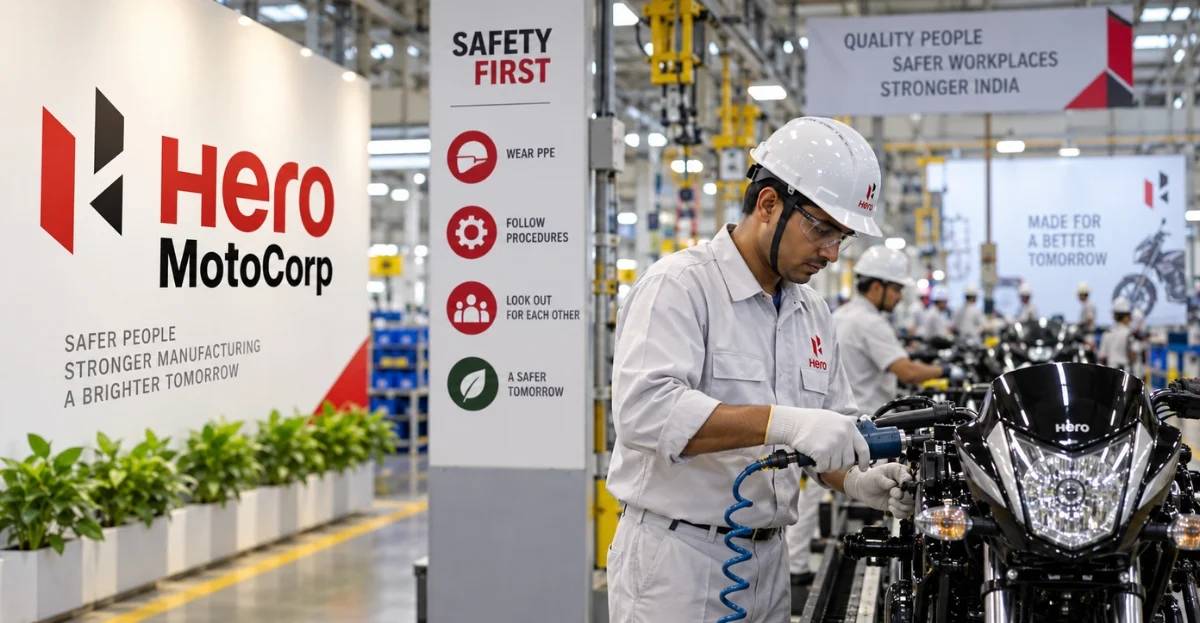
Six plants. Over 11.6 million two-wheelers a year in capacity. And a workforce that includes everyone from a fresh line operator in Neemrana to a plant head in Vadodara whose KPI sheet literally lists “zero accidents” as a line item next to production cost. That’s the scale problem Hero MotoCorp has to solve when it talks about safety culture in manufacturing – and scale is exactly where most safety programs quietly fall apart.
Talk to enough plant HR heads and you’ll hear the same complaint: safety policies read beautifully in the handbook and evaporate the moment a shift supervisor is racing to hit a production target. Hero MotoCorp’s approach is worth studying precisely because it tries to close that gap between paper and the shop floor, not because it claims to have solved safety once and for all. No manufacturer gets to say that honestly.
The ISO 45001 Backbone Across Six Plants
Hero MotoCorp runs manufacturing facilities in Gurugram and Dharuhera (Haryana), Haridwar (Uttarakhand), Neemrana (Rajasthan), Vadodara (Gujarat), and Chittoor (Andhra Pradesh). Every one of them operates under ISO 45001-certified Occupational Health and Safety management systems, which isn’t a small compliance checkbox – it’s a framework that forces an organization to systematize hazard identification, risk assessment, and incident response instead of leaving it to individual supervisors’ judgment. If you want to understand what that certification actually commits a company to, the ISO 45001 standard overview is a good primer – it covers the Plan-Do-Check-Act cycle that underpins most serious industrial safety systems.
What that looks like in practice at Hero MotoCorp: regular safety audits, structured training, and safety drills, with an emphasis on getting employees to think in terms of risk rather than just following a rulebook. That distinction between rule-following and risk-thinking matters more than it sounds. Rules cover the hazards someone already wrote down. Risk-based thinking is what catches the ones nobody anticipated – a new supplier part that behaves differently on the line, a maintenance shortcut that seemed harmless last Tuesday.
Safety Shows Up in the Job Description, Not Just the Training Calendar
Here’s a detail that tells you more than any mission statement: Hero MotoCorp’s plant leadership roles have safety written directly into their KPIs. A Head of Department role at the company’s Vadodara frame plant lists “Culture Building” as a core responsibility – specifically, cultivating a “Safety First” and “First Time Right” quality culture aimed at zero accidents and defect-free production, sitting right alongside cost reduction and equipment effectiveness targets.
That’s a meaningful signal for HR teams elsewhere in manufacturing. When safety is a soft add-on to a plant manager’s job – something reviewed once a quarter – it competes for attention with production numbers and loses. When it’s baked into the same KPI sheet as OEE and cost, a plant leader can’t quietly deprioritize it without the number showing up in their own performance review. It stops being a separate conversation and becomes part of how the plant is actually run.
The Gurugram Recognition – and What It Actually Signals
In late 2024, Hero MotoCorp’s Gurugram manufacturing facility was honored for its work on health, safety, and employee wellbeing, with the company crediting the facility’s commitment, dedication, and professionalism in its official disclosure to stock exchanges. You can read the original filing in Hero MotoCorp’s NSE stock exchange intimation.
An award is just a data point, not proof of a finished job – no single recognition tells you how a plant handles the next equipment failure or the next new hire who skips a lockout procedure under pressure. What it does tell you is that the company is willing to put safety recognition in a regulatory filing next to a marketing campaign announcement, treating it as material enough to disclose. That’s a different signal than a plaque in a lobby.
Extending the Standard Past the Factory Gate
A safety culture that stops at the company’s own payroll isn’t really a culture – it’s a perimeter. Hero MotoCorp’s Sustainable Partner Development Program pushes safety, environmental performance, and worker welfare requirements into its supplier and dealer network as part of the criteria for doing business with the company, with annual reviews of compliance and ESG elements built into the relationship.
This is where a lot of manufacturing safety programs quietly give up. It’s one thing to run drills in your own plant. It’s much harder to hold a third-party vendor to the same bar, especially when that vendor is competing on price. Building supplier reviews into the partnership terms, rather than treating them as a one-time audit at onboarding, is the part worth stealing if you’re an HR or procurement leader trying to close that exact gap in your own supply chain. It’s the same cross-functional thinking behind Amazing Workplaces’ evaluate-enrich-endorse approach to people practices – culture doesn’t hold if it only applies to people on your own payroll.
Related Posts
What Other Manufacturers Can Actually Take From This
A few things generalize beyond one company’s plant network:
Put safety in the same KPI sheet as production: Not a separate scorecard reviewed by a different committee – the same one a plant leader gets judged on every quarter.
Certify, don’t just declare: ISO 45001 forces documentation and audit trails that a homegrown “we care about safety” policy simply doesn’t. It’s slower to set up, and that’s the difference between a culture and a slogan.
Push the standard into your supply chain: Your safety record is only as strong as the weakest link in your vendor network, and that link is invisible until something goes wrong.
None of this makes a factory floor risk-free – heavy machinery, shift work, and six-figure employee counts mean the work is never actually finished. What separates a company that’s serious about this from one that isn’t is whether safety shows up in the paperwork that actually gets audited: job KPIs, stock exchange filings, supplier contracts. That’s a harder thing to fake than a poster in the break room.
Disclaimer: This article is for informational purposes only. While efforts are made to ensure accuracy, readers should verify information and seek professional advice as needed.