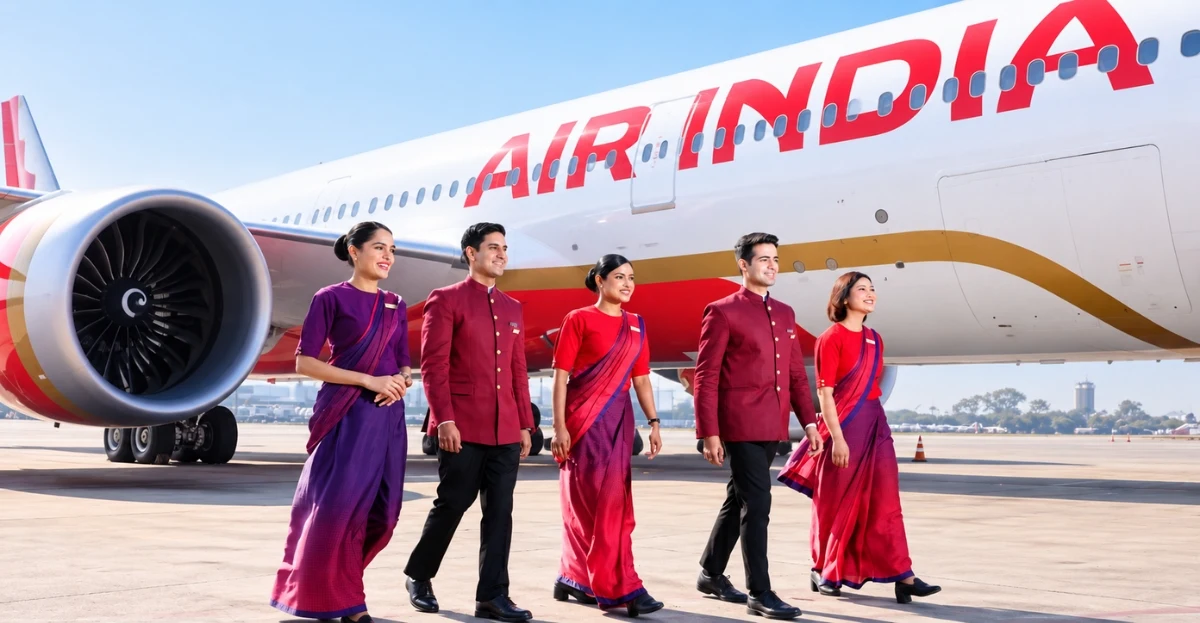
Image Source: https://www.airindia.com/in/en/newsroom/articles/Air-India-s-people-transformation-Rebuilt-for-scale-performance-and-the-future.html
In January 2022, Tata Sons took back an airline it had founded ninety years earlier. Air India wasn’t just old by then. It was tired – a government carrier with a workforce whose average age sat at 54, a merger with Indian Airlines still unresolved fifteen years later, and a reputation problem that had nothing to do with aircraft and everything to do with people.
Four years on, the average age of that workforce is 34. Nearly 5,000 people were hired in eighteen months. Four airlines – Air India, Vistara, Air India Express, and AirAsia India – got folded into one structure. And in April 2026, the CEO who ran that turnaround, Campbell Wilson, stepped down, handing the culture project to a successor mid-flight.
This is a story about Air India’s culture transformation – what Tata actually did differently, what it cost them, and what broke along the way. For HR leaders watching a merger or acquisition land on their own desk, it’s a useful case to sit with.
What Tata Actually Inherited
Forget the “national carrier” branding for a second. What Tata bought in 2022 was a PSU (public sector undertaking) with a private-sector rulebook bolted on top, and a staff that had spent decades operating under civil-service incentives – seniority over performance, process over ownership, safety in the form of not being blamed rather than genuine accountability.
People who’d flown for Air India in its JRD Tata-era heyday of the 1960s and 70s still talked about it with pride. Everyone hired after 1978, when the government pushed Tata out of the chairman’s seat, inherited a slower, more bureaucratic version. Losses mounted. Talent left for Gulf and Southeast Asian carriers. By the time Tata came back, “culture change” wasn’t a nice-to-have. It was the whole point of the acquisition.
An HR executive interviewed by HRKatha around the handover put it plainly: leadership would have to communicate constantly about what the new culture and Tata values actually meant in practice – because simply announcing new ownership doesn’t rewire twenty years of habits.
The Workforce Reset: Vihaan.AI
Tata’s answer had a name: Vihaan.AI, a five-year transformation roadmap covering fleet, technology, safety, and – critically – people. On the workforce side, three things happened in parallel.
First, hiring at scale. Roughly 5,000 new employees joined within eighteen months of the takeover, mostly younger, mostly hired against a different set of criteria than the PSU era used. That’s how the average age moved from 54 to 34 – not through attrition alone, but through a deliberate infusion of new blood.
Second, consolidation. Vistara (the Tata-Singapore Airlines joint venture) merged into Air India in November 2024. AirAsia India folded into Air India Express. Four separate airline cultures, four separate HR systems, four sets of employee expectations – collapsed into one. Anyone who’s run a post-merger integration knows this part is where culture work either sticks or quietly fails, because you’re not building a culture from scratch. You’re negotiating four of them into one.
Third, physical consolidation. Air India moved its scattered, government-owned offices across Delhi into a single campus in Gurugram. Small detail, big signal – Wilson himself described it as less about real estate and more about giving departments a reason to actually collaborate instead of operating in regional silos.
Building Capability, Not Just a New Logo
Anyone can commission a new livery. Air India did that too, in August 2023 – a new red-and-purple design, the window motif moved to the tail. But logos don’t retrain a pilot corps or convince ground staff that safety reporting won’t get them punished.
What’s harder to fake: Air India built South Asia’s largest training academy, two flight simulator facilities, a dedicated flying school, and a greenfield MRO (maintenance, repair and overhaul) base – infrastructure investments that only make sense if you’re planning to develop people over a decade, not a quarter. This is the part of the transformation that rarely makes headlines, and it’s also the part that’s hardest for a competitor to copy quickly.
How did Air India rebuild its culture after the Tata acquisition? Mainly through three moves: replacing over half the workforce with younger hires inside two years, merging four separate airline cultures into one operating structure, and investing in training infrastructure (a dedicated academy, simulators, and a flying school) rather than relying on rebranding alone.
Related Posts
The Test Nobody Wanted
Culture change looks good in a press release. It gets tested in a crisis. On June 12, 2025, Air India Flight 171 crashed shortly after takeoff from Ahmedabad, bound for London. It was the kind of event that exposes, brutally and immediately, whether a safety culture is real or just a slide in a townhall deck.
By October 2025, at an industry conference, Wilson was still talking about the transformation – but the tone had shifted. The word “compassion” showed up next to “leadership” in coverage of his remarks, and for good reason. A culture rebuild that only optimizes for speed and modernization runs out of credibility the moment something goes badly wrong. What employees remember afterward isn’t the new seat pitch. It’s whether leadership showed up, took responsibility, and changed anything as a result.
Leadership Transition, Mid-Rebuild
Then, in April 2026, Wilson resigned. According to Air India’s own statement, he’d told Chairman N. Chandrasekaran back in 2024 that he intended to step down in 2026, and had spent the intervening period preparing the organization for a handover rather than leaving abruptly. The official announcement credited the period with “the acquisition and successful merger of four airlines, an evolution from public to private sector practices along with renewal of the leadership team, workforce, culture and ways of operating.”
His successor, Tewolde Gebremariam – previously CEO of Ethiopian Airlines Group – held his first town hall with employees soon after. One message dominated: safety comes first. Not growth, not the fleet order, not the international route map. For a workforce that had lived through the Ahmedabad crash less than a year earlier, that sequencing mattered more than any slogan could.
This is the part most coverage of Air India’s turnaround misses, because it’s recent enough that the story hasn’t fully settled: culture transformation doesn’t end when the CEO who started it leaves. It either survives the handover intact, or it turns out the whole thing was one executive’s personal project. Air India is mid-test on that question right now.
What HR Leaders Can Actually Take From This
A few things generalize beyond aviation.
Age and tenure resets are blunt but effective. Bringing in nearly 5,000 new hires in eighteen months isn’t subtle, and it isn’t painless for the people who leave or feel sidelined. But when a legacy culture is genuinely calcified, gradual change often isn’t fast enough to matter.
Infrastructure investment is a culture signal, not just a capability one. A training academy and simulator facilities tell employees something a values poster on the breakroom wall never will: that leadership is planning for who they’ll become, not just what they’ll produce this quarter.
Crisis response is where culture claims get audited. If your organization has spent two years saying “we’ve changed,” the first serious failure is where employees, customers, and regulators find out whether that’s true.
And continuity through leadership change is the real stress test. If you’re leading a culture initiative right now, ask what happens to it if you left tomorrow. Air India’s answer is still being written – organizations that want to measure whether their own culture claims hold up under a confidential employee survey can start with the Amazing Workplaces certification process rather than waiting for a crisis to find out.
The Verdict, For Now
Air India’s culture transformation is real, not cosmetic – the workforce is younger, the training infrastructure is genuinely new, and the four-airline merger has largely happened. It’s also unfinished, and it’s now being carried by a CEO who wasn’t there when it started. For anyone studying this as a case, the detailed public commentary from Air India’s leadership at APEX EXPO 2025 is worth reading directly, because the specifics of intent tell you more than outcome metrics alone. That’s true of most acquisitions, not just this one. Organizations exploring what a rigorous, people-first approach to culture and employer branding looks like in practice can see it laid out on Amazing Workplaces.
Disclaimer: This article is for informational purposes only. While efforts are made to ensure accuracy, readers should verify information and seek professional advice as needed.