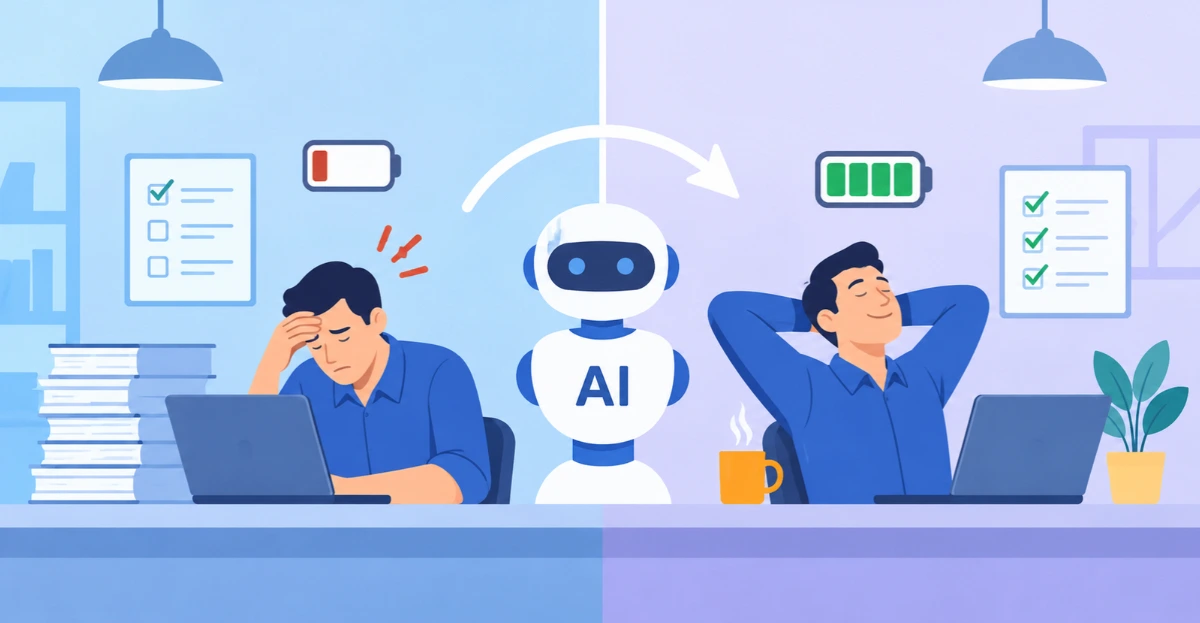
Your team got an AI assistant six months ago. A report that took a full day now takes two hours. Good news. So why does everyone look more tired?
That question sits behind rising AI productivity expectations. The tool did what it promised, and then the targets moved. This article looks at what 2026 research says about that pattern, who ends up carrying the cost, and what people leaders can do before speed quietly becomes the new baseline.
Is AI making work better or just raising productivity expectations?
AI does both. It speeds up drafting and summarizing, yet AI productivity expectations tend to rise with every hour saved. A 2026 Harvard Business Review study found workers took on more, not less. Work improves only when leaders decide, before rollout, what happens to the hours AI frees up.
The technology and the workplace are two separate variables. AI changes how fast a task gets done. What the company does with the saved time decides whether employees feel any benefit. Most organizations haven’t made that decision on purpose, so it gets made by default. The default is more work.
What the 2026 research shows
In February 2026, Harvard Business Review published an eight-month study by Aruna Ranganathan and Xingqi Maggie Ye of UC Berkeley’s Haas School of Business. They followed about 200 employees at a US tech company that gave everyone AI subscriptions but didn’t require anyone to use them. Their conclusion: the tools didn’t reduce work. They intensified it.
Nobody sent a memo asking for more. People did more on their own because AI made extra work feel doable. Product managers started writing code. Breaks got thinner. One engineer described it plainly: the time saved never turned into time off.
Gallup’s 2026 survey of 23,717 U.S. employees points the same way. Inside organizations that have adopted AI, 65% of employees say it has improved their productivity and efficiency. Yet relatively few say it has fundamentally changed how work gets done across the organization.
Read that gap slowly. People feel faster. The organization hasn’t redesigned roles or workflows around that speed. So the speed lands on top of the existing job.
How expectation creep happens without anyone deciding it
It rarely starts with a directive. It starts with a data point.
A manager sees another team turn around a client proposal in one morning. Next quarter’s planning assumes every team can. Nobody lied. Nobody checked what that quick version cost in review time, rework or plain attention.
Fear keeps the cycle going. In the 2026 LSE and Protiviti generational AI report, 48% of employees said they worry about being judged for not keeping up with AI. Gallup found that 18% of U.S. employees think their job could be eliminated within five years because of AI or automation, and that figure rises to 23% inside organizations that have adopted it. When nearly one in five people fears for their job, saying “this pace is too much” feels risky. My reading is that people absorb the new pace quietly, and the numbers on a dashboard look great right up until someone resigns.
Where AI does make work better
We don’t buy the argument that AI is only a stress machine. The same LSE and Protiviti report found that 82% of employees say AI helps them finish tasks faster and 70% say it reduces mental effort. Those gains are real, and they cluster in repetitive work: first drafts, meeting summaries, data cleanup, hunting through a long document for one clause.
Work gets better when AI takes the tasks people never liked and leaves the judgment calls with them.
The trouble starts when freed-up hours are treated as spare capacity instead of room for recovery, learning or checking quality. The report’s authors make the same warning: if organizations simply absorb the gains into existing workloads, most of AI’s value goes unused.
Related Posts
Who carries the load
Gains are not spread evenly. In Gallup’s data, 21% of leaders say AI has had an extremely positive effect on their productivity, against 13% of individual contributors. Workers in service and office administrative support roles were more likely to report little or no effect, or a negative one.
PwC’s Global Hopes and Fears survey of nearly 50,000 workers adds another piece. Only 14% use generative AI daily, and just 51% of non-managers say they have the learning resources they need, compared with 66% of managers and 72% of senior executives.
That’s the part that should bother HR teams. The people who benefit most are often the ones setting the expectations. The people absorbing those expectations have less training and less say.
For a senior leader’s view on the people side of this shift, read our interview with Subramanyam Sreenivasaiah on building future-ready, human-centric workplaces.
How to keep AI productivity expectations realistic
- Decide where the saved time goes: Before rollout, agree what share goes to quality, learning, recovery and review. If you skip this, new volume fills the space automatically.
- Reset targets with data, not demos: A demo shows the best case. Measure real cycle times over a full quarter, including review and rework, and only then change the targets.
- Set norms for how AI is used: The HBR authors suggest building an “AI practice”: deliberate pauses before big decisions, sequencing work to cut context-switching, and protected time for human conversation. Without norms, every person invents their own pace.
- Train non-managers first: The learning gap above is the quickest to close. People who understand a tool push back on bad outputs and on bad deadlines.
What to ask employees in your next survey
You can’t fix what you only assume. Four questions worth adding to any pulse check:
- Has AI changed how much work you’re expected to finish in a week?
- Has anyone told you what to do with the time AI saves?
- Do you feel judged if you use AI less than your peers?
- Do you have the training you need to use AI well?
Amazing Workplaces® has surveyed over 60,000 employees across India and global markets. If you want a confidential read on how your own people experience this shift, our survey and certification program is one place to start.
Frequently asked questions
Does AI reduce workload?
Not by default. The Berkeley Haas study found AI intensified work, and Gallup’s data shows individual gains with few redesigned workflows. Workload only falls when the organization redesigns roles and targets around the new speed.
Why does AI raise productivity expectations?
Faster output becomes the new benchmark. Leaders see a speed gain and fold it into targets, while employees fill the freed time with extra tasks on their own.
Is AI good for employee experience?
It can be. It helps when it removes repetitive tasks and comes with training and clear norms. It hurts when it adds pace without support or feeds job insecurity.
How should managers measure AI productivity?
Track outcomes: quality, cycle time including rework, and customer results. Add employee workload and burnout signals. Counting tasks completed rewards pace over value.
So, better or just more?
For a lot of employees right now, it’s more. That can change, but it takes one decision that most companies haven’t made yet: what is the time AI gives back actually for?