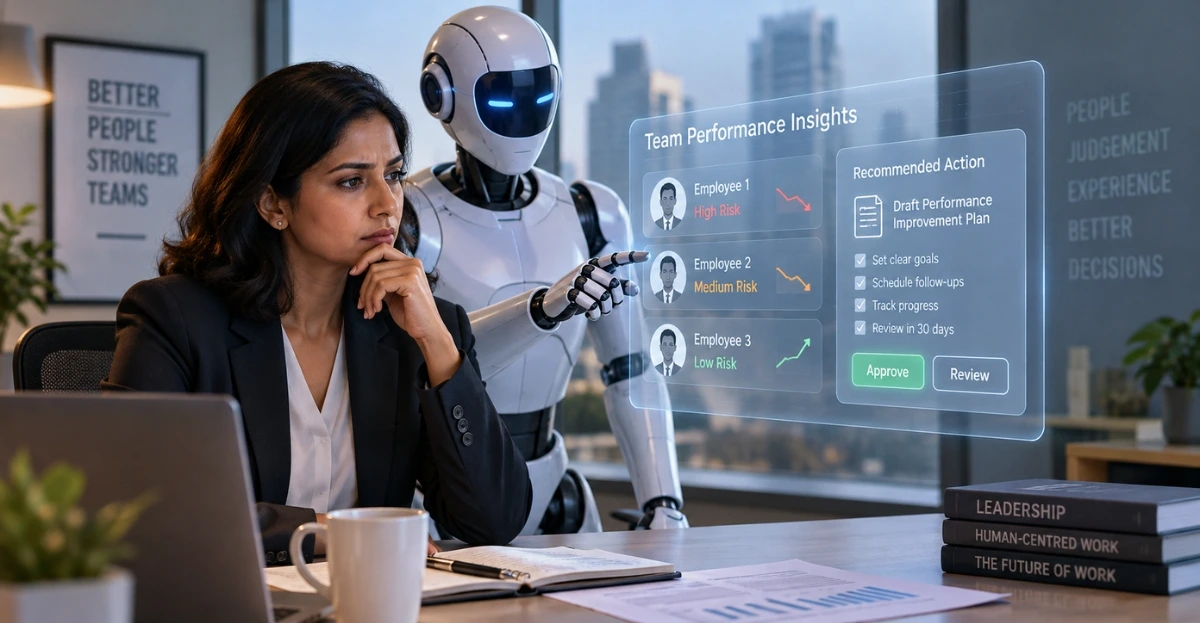
A regional sales manager gets a Monday morning alert. The system has already flagged three underperforming reps, ranked them by “risk of attrition,” and drafted a performance improvement plan for the lowest scorer. All she has to do is click approve.
She doesn’t click approve. She reads the file for a while, then picks up the phone and calls the rep instead. He’s dealing with a sick parent. The dip in numbers is temporary. The AI didn’t know that. It couldn’t have.
That gap – between what a system can calculate and what a manager can actually see – is where this whole conversation lives right now.
For years, AI in the workplace meant dashboards. Reports. Predictions a human still had to act on. That’s changing fast. AI tools are moving from informing decisions to making them – who gets flagged for review, which shift gets approved, which candidate moves forward. The question isn’t whether AI belongs in management anymore. It’s how much of the decision managers are willing to hand over, and whether they’ve actually thought that through.
What “sharing control” really means
Sharing control doesn’t mean a manager and an algorithm split a decision fifty-fifty. In practice, it looks like three different levels, and most companies are mixing all three without saying so out loud:
- AI recommends, human decides: The system surfaces an option; a person still signs off. This is where most HR tech sits today – performance flags, scheduling suggestions, candidate shortlists.
- AI decides, human can override: The default action happens automatically unless someone intervenes. Think auto-approved leave requests or dynamic shift assignments.
- AI decides, human finds out later: Rare in HR still, but common in adjacent functions like fraud detection and dynamic pricing. It’s the model everyone’s watching, because it’s where things go wrong fastest if nobody’s paying attention.
AI agents are already showing up as coworkers inside HR teams – scheduling interviews, drafting job descriptions, triaging employee queries. The step from “coworker that assists” to “coworker that decides” is smaller than most managers realize.
Where this is already happening
Ask most managers if AI is making decisions in their org and you’ll get a quick “not really.” Ask what happens when someone applies for a job, requests time off, or gets flagged in a performance dip, and the answer gets murkier.
A few places it’s already live:
Hiring: Resume screening tools don’t just sort applications anymore – many rank and reject before a recruiter ever opens the file. The human “decision” is often just not undoing what the system already did.
Performance management: Systems that track output, tag “at-risk” employees, and generate review drafts are standard in larger companies now. The manager edits. Sometimes.
Scheduling and workload distribution: In retail, logistics, and BPO environments, shift and task allocation is frequently fully automated, with a manager checking exceptions rather than building the schedule.
Promotion and pay recommendations: Less common, but growing – models that flag “ready now” employees based on tenure, project completion, and peer feedback scores.
None of this is science fiction. It’s Tuesday.
Why managers are hesitant – and it’s not just ego
There’s a temptation to frame manager resistance to AI as turf protection. Sometimes it is. Mostly it isn’t.
McKinsey’s State of Organizations 2026 research found that respondents expect AI to act mainly as a support tool in the near term, with younger leaders more open to giving it an autonomous role. That gap between generations isn’t about comfort with technology. It’s about accountability. A manager who approves a system’s recommendation and gets it wrong still owns the outcome – the system doesn’t sit in the room during the difficult conversation that follows.
Three things drive the hesitation, in order of how often we hear them from HR leaders:
- Accountability doesn’t transfer. If an AI-driven decision hurts someone – a wrongful termination flag, a missed promotion – the manager’s name is still on it, not the vendor’s.
- Context loss. Models work off data. They don’t know about the sick parent, the reorg rumor, or the fact that an employee just came back from bereavement leave.
- Trust erosion with teams. Employees who sense a decision came from a system, not a person, tend to disengage from the process – even when the outcome is fair.
None of that means managers should resist the shift. It means the shift has to be designed with these gaps in mind, not around them.
Related Posts
The real risk isn’t a bad AI decision – it’s an unowned one
Here’s where it gets more interesting than “AI good, AI bad.”
Commentary on McKinsey’s 2026 AI Trust survey has zeroed in on a structural problem: most governance frameworks assume decisions are single, isolated events with a clear approval step. Agentic AI doesn’t work that way. It retries. Adjusts. Chains one decision into the next without stopping at the point a human would have. The failure mode isn’t one wrong call – it’s a decision loop nobody designed an exit from.
Gartner’s research points at the same gap from a workforce angle. The firm predicts that by 2027, half of enterprises without a people-centric AI strategy will lose their top AI talent, and notes that managers are best positioned to fold AI into daily workflows and address workforce anxiety about it early. Put those two findings together and the picture is clear: the tools are ahead of the governance, and managers are the ones left holding the gap.
Only around 30% of organizations in McKinsey’s 2026 AI Trust Maturity Survey scored at maturity level three or higher on governance and agentic AI controls – even though the overall trust maturity score rose to 2.3 from 2.0 the year before. Progress is real. It’s just uneven, and it’s landing unevenly on the people who manage teams day to day.
What managers can actually do about it
This isn’t a “resist the robots” list, and it isn’t a “get out of the way” list either. It’s closer to a set of guardrails a manager can put in place this quarter, not next year.
Draw the line before the system does: Decide explicitly which calls stay fully human – terminations, disciplinary action, anything touching pay equity – and which ones can run on an AI-recommend model. Write it down. Don’t let the default settings in the software make this decision by accident.
Ask what data trained the recommendation: If a performance flag comes from a system, ask what it’s weighing. Output volume? Peer ratings? Attendance? A manager who can’t answer that question in a one-on-one has already lost control of the decision, whether they signed off on it or not.
Keep an override log: Track when and why a manager overrides an AI recommendation. Over six months, that log tells you more about whether the tool is actually helping than any vendor dashboard will.
Loop employees in on what changed: People tolerate AI-assisted decisions far better when they know a system played a role and understand what a human still checks. Silence about it breeds more distrust than the AI itself does.
Build the muscle before the crisis: Waiting for a bad AI-driven decision to force a policy conversation is the expensive way to learn this. Organizations doing this well are testing override protocols and escalation paths now, on low-stakes decisions, so the process is already familiar when the stakes go up.
Where human judgment still wins, full stop
None of this is a case against AI in management. The scheduling tool that used to take a manager four hours now takes four minutes, and the four minutes are usually right. That’s a real gain, not a talking point.
But the sales manager from the opening story is the reminder worth keeping. She had context the model never had access to. A system optimizing for “risk of attrition” had no way to weigh a sick parent against a quarterly number. That kind of judgment – reading a situation that doesn’t show up in the data – is exactly what doesn’t automate well, and it’s the reason “manager” is still a job title and not a workflow.
Leaders who are already navigating this well tend to treat AI as a tool that clears space for judgment, not a replacement for it. That distinction – narrow but important – is probably the single biggest predictor of whether an organization’s AI rollout builds trust or burns it.
The bottom line
AI is getting closer to the decisions managers used to own outright, and it’s happening faster than most policy documents can keep up with. The organizations handling this well aren’t the ones with the most advanced tools. They’re the ones that decided, in advance, exactly where the human stays in the loop – and built the habit of checking that line before a bad decision forces the conversation.
Managers don’t need to be ready to hand over control completely. They need to be ready to say, clearly, where they won’t.