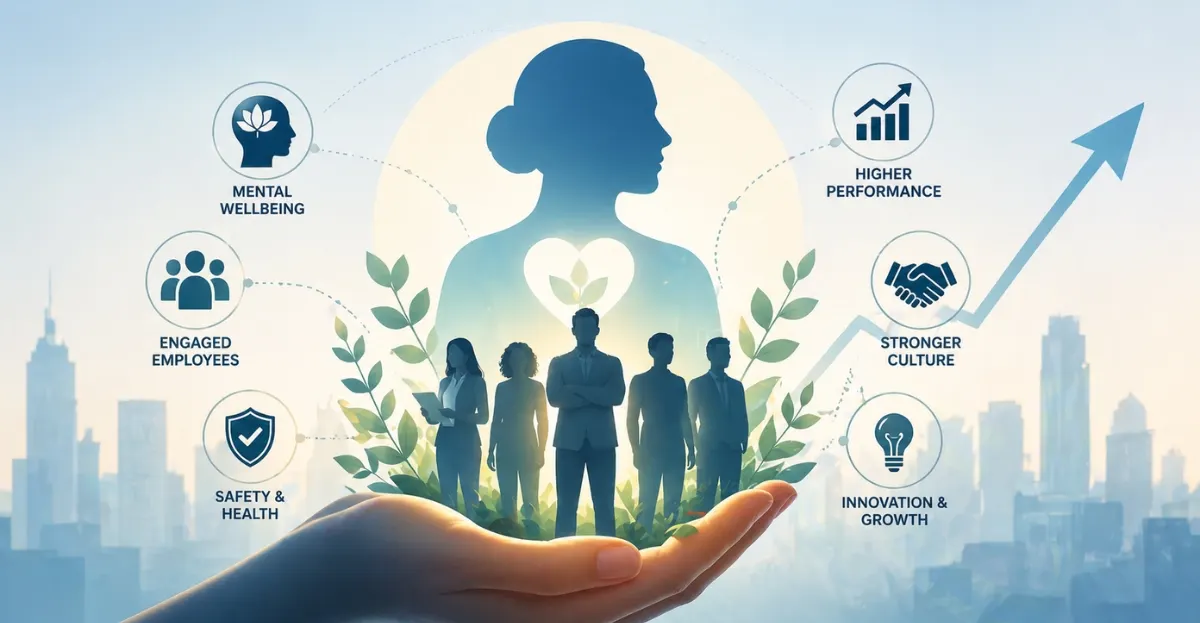
When Protecting Your People Becomes Your Competitive Advantage
For decades, employee wellbeing lived in the margins of organizational strategy – a line item under “perks,” sandwiched between ping pong tables and fruit baskets. That’s changing. Across industries, forward-thinking organizations are recognizing that how they protect and support their people isn’t a secondary concern. It’s the strategy itself.
And nowhere is this shift more urgent, or more consequential, than in professions where the work environment poses a direct threat to the health of the people doing it.
The Wellbeing Imperative: From Nice-to-Have to Business Critical
Research from the University of Oxford’s Wellbeing Research Centre has drawn a direct line between employee wellbeing and organizational financial performance, finding that companies with higher wellbeing scores consistently achieve greater valuations and superior returns. McKinsey research has found that wellbeing interventions correlate with productivity improvements of between 10 and 21 percent.
The message is clear: investing in people isn’t philanthropy. It’s a performance strategy.
But here’s what makes the current moment different. The conversation has moved beyond gym memberships and mental health apps. Leading organizations are now asking a deeper question: Are the systems, environments, and tools our people interact with every day actually designed with their wellbeing in mind – or are we asking them to adapt to systems that were never built for them?
Rethinking Wellbeing in High-Stakes Environments
Consider the fire service. Firefighters face one of the most dangerous occupational health profiles of any profession. Cardiovascular disease is the leading cause of on-duty firefighter deaths in the United States, accounting for roughly 45% of line-of-duty fatalities. Research published in the New England Journal of Medicine found that the risk of cardiac death during emergency response is dramatically higher than during non-emergency duties – in some cases 10 to 100 times higher.
The causes are multifaceted: physical exertion, environmental exposure, chronic sleep disruption, and the repeated physiological shock of sudden emergency alerts. Imagine being jolted awake at 2 a.m. by blaring sirens and blinding lights, night after night, year after year. The cumulative cardiovascular toll of that stress isn’t abstract. It’s measurable – and it’s deadly. Research into alerting design has begun quantifying exactly how station environment factors like abrupt tones and lighting transitions contribute to that risk over a career.
For a long time, this was simply accepted as part of the job. The alarm goes off, you respond. That’s what firefighters do.
But what if the alarm itself could be reimagined?
Designing for the Human: Wellbeing as an Engineering Problem
This is exactly where the most progressive thinking in public safety technology is heading. Fire station alerting systems – once designed purely around functional performance – are increasingly being redesigned with the responder’s physiology in mind.
The traditional jarring siren-and-floodlight combination is effective at waking people. It’s also effective at triggering an immediate cardiovascular stress response. Modern approaches replace that jolt with ramping tones: gradual, escalating audio cues that bring responders to alertness without a sudden spike in heart rate. Carefully calibrated lighting preserves night vision and reduces disorientation. Targeted alerting systems wake only the crews assigned to a specific call, allowing others to continue resting.
Related Posts
Automated voice dispatch gives firefighters critical call information before they’ve left their beds, improving situational awareness while reducing the cognitive chaos of a traditional alert. These aren’t small quality-of-life improvements. They’re design decisions that directly address the cardiovascular risk profile of one of the most dangerous professions in the country.
The result is a system that doesn’t just maintain response times – it improves them, while reducing the cumulative physiological stress on every firefighter in the station.
The Broader Lesson: Wellbeing Is a Design Problem
What’s happening in fire station alerting offers a powerful lesson for every industry. Too often, organizations treat wellbeing as something layered on top of existing systems – a wellness program grafted onto a workplace that was designed without people’s health in mind. The most progressive organizations are flipping this model. They’re asking: What if we designed the work itself – the tools, the processes, the environment – around human wellbeing from the start?
This is the future of employee wellbeing as strategy. It’s not about offering more benefits. It’s about building workplaces, systems, and technologies where caring for people is embedded in the architecture of how work gets done.
In the fire service, that means an alerting system that wakes you gradually instead of shocking your heart. In a corporate office, it might mean communication tools designed to protect focus rather than fragment attention. In a manufacturing plant, it could mean equipment interfaces engineered to reduce cognitive load and fatigue.
The principle is the same: when you design for the human, performance follows.
Why This Matters Now
The workforce is paying attention. Employees across every sector are increasingly evaluating employers not just on compensation and career growth, but on whether the organization genuinely prioritizes their health and safety. Gallup’s research indicates that only one in four U.S. employees strongly agree their organization cares about their overall wellbeing – a staggering gap between intention and perception.
Organizations that close this gap won’t do it with slogans or surveys alone. They’ll do it by making tangible, visible investments in the systems and environments their people interact with daily. They’ll do it by asking not just whether the work is getting done, but whether the conditions under which it’s being done are actively protecting the people doing it.
The future of work isn’t just about where we work or when we work. It’s about whether the places and tools we work with were built with our wellbeing at their core.
The organizations that get this right won’t just attract talent. They’ll keep people healthy, engaged, and performing at their best – for years to come.