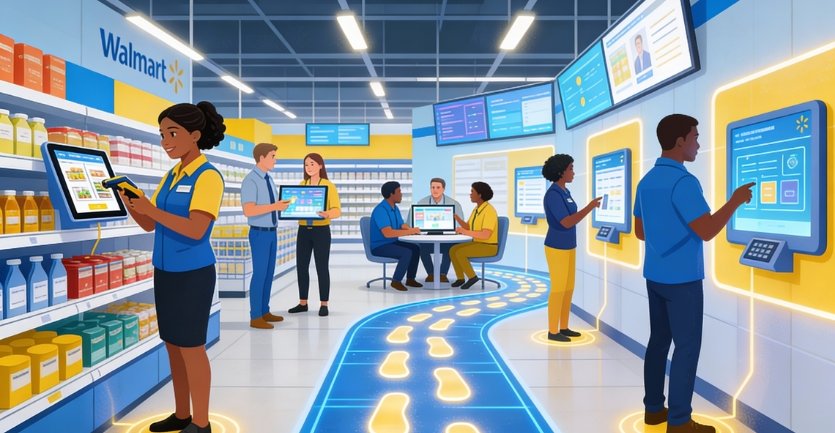


The retail sector is currently facing a dual challenge: a tightening labor market and the rapid integration of advanced technology. In this environment, the traditional entry-level role is being replaced by a more specialized, tech-driven position.
Walmart, the world’s largest private employer, has responded by shifting its strategy to focus on skills-based growth. By treating the frontline as a talent pipeline rather than a revolving door, Walmart is redefining the experience of retail work.
This approach strengthens their employer branding and ensures the company remains “people-led and tech-powered.” It is a fundamental shift in how large-scale organizations manage human capital.
Live Better U: The $1 Billion Investment in Skills
At the heart of the strategy is the Live Better U (LBU) program. Launched in 2018, LBU has evolved from a simple tuition assistance plan into a comprehensive career accelerator.
As of 2025, Walmart has committed nearly $1 billion toward skills training through 2026. The program is notable for its accessibility. Eligible associates can access 100% tuition coverage for degrees and certification programs starting on their first day of employment.
To date, more than 126,000 associates have participated, saving over $812 million in tuition costs. This investment directly impacts the company’s internal culture by fostering loyalty and long-term career planning.
Shifting to Short-Form Learning
What sets this model apart is the move toward “short-form” learning. Walmart recently doubled its certificate options to over 50. These programs focus on high-demand areas:
- Data science and analytics
- Software development
- Supply chain operations
- Pharmacy and healthcare services
These programs take roughly four months to complete. This allows workers to gain market-ready skills without a four-year commitment. It creates a flexible environment where learning fits into the flow of work.
The Academy: Scaling Leadership in Workplaces
Beyond external education, the Walmart Academy serves as one of the largest private training ecosystems in the world. With over 200 physical locations and a global digital platform, it has trained more than 3.5 million associates.
The Academy focuses on three critical areas:
- On-the-job mastery: Training for specialized roles like pharmacy technicians or cake decorators.
- Emerging tech: Introducing AI-powered tools for task management and real-time translation.
- Management training: Developing soft skills and operational excellence.
A key indicator of success for Leadership in workplaces is internal mobility. Currently, approximately 75% of Walmart’s U.S. store, club, and supply-chain management teams started as hourly associates.
Leveraging Data and Feedback
To ensure these programs align with employee needs, the company relies on internal data and workplace surveys. These insights help refine the curriculum.
By listening to the frontline, the company ensures that learning pathways are not just available, but also relevant. This feedback loop is essential for maintaining a high-quality employee experience.
Key outcomes from these surveys include:
Related Posts
- Increased retention rates among LBU participants.
- Faster promotion cycles for Academy graduates.
- Higher engagement scores in departments with active learners.
Vocational Pathways: From Store to Driver
Walmart’s strategy also includes highly specialized vocational tracks. The “Associate to Driver” and “Associate to Technician” programs are prime examples of this.
These initiatives allow store workers to transition into high-paying roles through internal training. For example:
- Truck drivers can earn up to $135,000 a year.
- Specialized technicians can earn roughly $45 an hour.
- Maintenance and facility roles provide clear wage progression.
By removing the college degree requirement for the majority of corporate and field roles, Walmart has made it clear: skills are the new currency.
Preparing for the AI-Powered Future
The latest evolution in the journey involves a 2025 initiative to integrate Generative AI training. Starting in 2026, frontline and office associates will have access to customized AI learning modules.
This initiative aims to demystify AI, teaching employees how to use digital assistants to:
- Streamline inventory management.
- Improve real-time customer service.
- Optimize logistics and routing.
This forward-thinking approach ensures the workforce is not replaced by technology, but rather empowered by it. This is how the company maintains its competitive edge in a digital-first economy.
Conclusion
The reinvention of retail work requires more than just a training budget; it requires a mindset shift. Walmart’s model shows that when an organization invests in the growth of its people, it creates a more resilient business.
By focusing on continuous learning, the company has built a sustainable model for the future of work. It proves that massive scale is not an obstacle to personalized career development.
Disclaimer: This article is for informational purposes only. While efforts are made to ensure accuracy, readers should verify information and seek professional advice as needed.