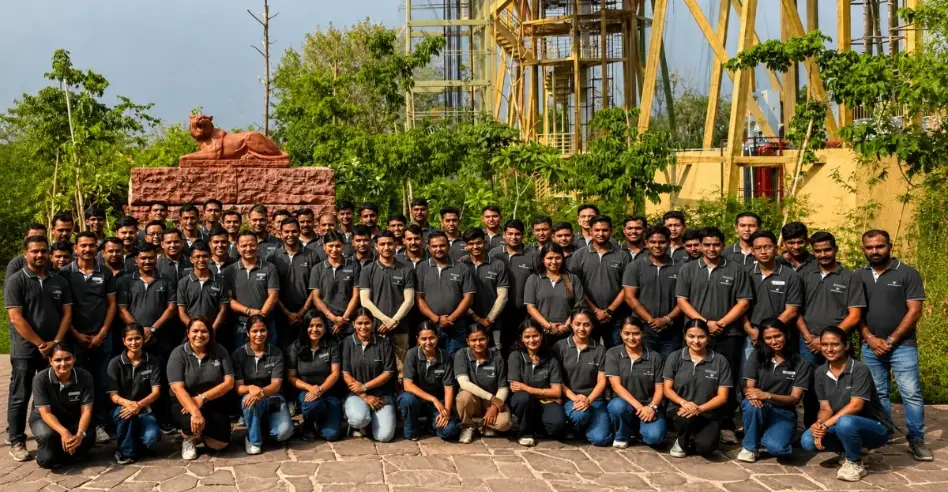
Image Courtesy: https://life.marriott.com/blog/opening-jw-marriott-ranthambore/
If you manage people in hospitality, or in any customer-facing industry, Marriott’s name comes up constantly in engagement conversations. Part of that is scale: with more than 9,400 properties and roughly 418,000 employees worldwide, Marriott International is one of the largest employers in the sector.
But the bigger reason is that Marriott has spent nearly a century building a specific, repeatable philosophy around its workforce, and it has kept adapting that philosophy through a merger, a pandemic that wiped out 90% of its revenue almost overnight, and the worst attrition crisis in the company’s history.
This piece breaks down what Marriott’s employee engagement strategy actually consists of: where it came from, what it looks like today, what the data says about whether it works, and where it still runs into the same pressures every hospitality employer faces. The goal is to give HR leaders and people-ops teams something they can actually borrow from, not a marketing summary.
Quick facts: Marriott’s employee engagement strategy at a glance
| Element | Detail |
| Founding philosophy | J. Willard and Alice S. Marriott’s 1927 belief that looking after employees is what leads employees to look after guests |
| Core program | TakeCare, a global wellbeing platform built on three pillars: opportunity, community, and purpose |
| Volunteer engagement network | More than 15,000 employees worldwide serve as TakeCare Champions or Ambassadors |
| Financial hardship support | The TakeCare Relief Fund awarded over $400,000 in grants in 2018 alone, plus $1.7 million in donations |
| Post-pandemic turnover crisis | One in four new hires quit within their first 90 days at the peak; applications per open role fell from roughly 25 to the single digits |
| Recovery | Marriott now averages around 32 applications per open position |
| Employees, worldwide | Approximately 418,000, as of 2024 |
| Properties | More than 9,400 locations worldwide |
Where the strategy actually comes from
Marriott’s engagement approach isn’t a program the company built for optics. It traces back to the founders’ original hotel business in Washington, D.C., where J. Willard and Alice Marriott operated on a simple premise: employees who feel looked after tend to look after guests, and that relationship is what actually protects the business.
That idea has stayed remarkably consistent through nearly a century of growth, multiple recessions, and a 2016 acquisition of Starwood Hotels that roughly doubled the company’s size overnight.
The Starwood integration is a useful case study in itself. According to Marriott’s former CHRO David Rodriguez, legacy Starwood properties reportedly came into the merger with stronger employee engagement scores than legacy Marriott properties, which forced the HR function to treat culture integration as seriously as systems integration. Leadership leaned on the existing TakeCare framework as the common language for merging two workforces, rather than building something new from scratch.
The TakeCare program: what it actually includes
TakeCare is the operational core of Marriott’s engagement strategy, and it’s broader than a typical corporate wellness benefit. It’s organized around three pillars, opportunity, community, and purpose, and rolls up several distinct initiatives:
- TakeCare Champions and Ambassadors: A volunteer network of more than 15,000 people, ranging from housekeepers to hotel general managers, who organize wellbeing activities and community service at the property level rather than waiting on directives from headquarters.
- TakeCare Relief Fund: A need-based grant program for employees facing personal hardship or natural disasters, which distributed over $400,000 in grants in 2018 alone.
- TakeCare Level30: A mobile app that gamifies wellbeing behaviors across physical, community, and purpose-driven activities, designed to nudge people toward offline habits rather than more screen time.
- Xposure: An internal mobility platform that gives employees exposure to other departments through cross-training, mentorship, and short-term project assignments.
- Where I Belong: An internal campaign focused specifically on belonging, aimed at making the “Marriott family” language feel concrete rather than decorative.
- Associate Resource Groups (ARGs): Employee-led networks that help the company reflect the lived experience of different backgrounds, roles, and regions in its policies and programming.
The design principle running through all of this is decentralization. Corporate HR sets the framework and provides central planning, but the actual delivery is pushed down to property-level “champions” who adapt it to their own teams. That matters in an industry where a corporate office in Bethesda, Maryland has very little in common, day to day, with a housekeeping team in Ho Chi Minh City.
What the data says about results
Employee engagement programs are only as credible as the numbers behind them, and Marriott’s public data gives a mixed but informative picture.
On the positive side, an industry HR report on Marriott’s culture found the company’s attrition rate ran roughly 11% below the industry average, while its engagement scores were about 22% higher. Marriott’s current Glassdoor rating sits at 3.9 out of 5 based on more than 21,000 reviews, a score that has held steady over the past year, and is respectable for a company operating at this scale in a historically high-turnover sector.
On the harder side, Marriott is not immune to the structural pressures facing hospitality broadly. Industry-wide, hospitality turnover in North America has run between 70% and 80% annually, driven by demanding schedules, comparatively low wages, and limited visible career paths. Marriott’s own post-pandemic experience reflects that reality directly.
According to CHRO Ty Breland, the company hit its highest turnover rate in its history in 2021 and 2022, with one in four new hires leaving within the first 90 days and applications per role falling into the single digits from a pre-pandemic average of around 25.
Marriott’s response is worth studying because it reframed the problem instead of just running another retention campaign. Breland has described a shift in how the company internally talks about frontline wages and benefits, moving away from treating them purely as a cost line and toward treating them as an investment that needs to show a return, in his words.
That reframing led to concrete operational changes: more part-time roles designed around school-hour availability, consistent (not last-minute) scheduling, the ability to swap or pick up shifts, and expanded reskilling and leadership-development tracks for frontline associates. Those changes, combined with the existing TakeCare infrastructure, have pushed applications per role back up to roughly 32, above the pre-pandemic baseline.
Related Posts
Where the strategy still faces real limits
A useful engagement case study doesn’t pretend the underlying industry pressures have disappeared, and Marriott’s don’t. Hospitality wages remain structurally lower than the broader private-sector average, tipped and hourly roles still create income instability, and unpredictable scheduling remains one of the strongest predictors of turnover across the sector. TakeCare and the post-pandemic scheduling changes address real pain points, but they operate on top of an industry-wide wage and staffing problem that no single employer program fully solves on its own.
That’s actually the more useful takeaway for HR leaders outside hospitality: engagement programming works best as a layer on top of competitive pay and reasonable scheduling, not as a substitute for either.
What HR and people-ops teams can take from Marriott’s approach
A few patterns from Marriott’s strategy translate well beyond hotels:
- Anchor the program in a philosophy employees can repeat back, not a slogan: The “take care of employees so they take care of customers” logic has survived because it’s simple enough to explain in one sentence and specific enough to act on.
- Push delivery to the frontline, not just to HR: A 15,000-person volunteer ambassador network scales culture in ways a corporate wellness team of a few dozen people never could.
- Treat frontline flexibility as a retention lever, not a perk: Predictable scheduling and part-time options built around real-life constraints did more to fix Marriott’s post-pandemic turnover than any single wellbeing initiative.
- Reframe cost conversations as investment conversations: The internal shift in how Marriott’s HR function talks about wages and benefits changed what leadership was willing to fund.
- Measure it, don’t just run it: Marriott’s willingness to publish attrition and engagement comparisons against industry benchmarks is what makes the program a case study instead of a claim. Structured, benchmarked employee-experience surveys and workplace assessments are what let any organization, not just one with Marriott’s resources, tell the difference between a program that feels good and one that actually moves retention.
Frequently asked questions
What is Marriott’s employee engagement strategy called?
Marriott’s primary engagement platform is called TakeCare, a global wellbeing program organized around three pillars: opportunity, community, and purpose. It sits inside a broader “people-first” philosophy the company traces back to its 1927 founding.
How many employees does Marriott have, and how big is TakeCare’s reach?
Marriott employs approximately 418,000 people across more than 9,400 properties worldwide. More than 15,000 of them volunteer as TakeCare Champions or Ambassadors who run the program at the property level.
Did Marriott’s engagement strategy actually reduce turnover?
Pre-pandemic data suggested Marriott’s attrition ran about 11% below industry average with meaningfully higher engagement scores. Turnover still spiked sharply during and after the pandemic, with one in four new hires leaving within 90 days at the peak. Since then, scheduling and flexibility changes have helped push applications per role back above pre-pandemic levels.
Is Marriott’s approach specific to hospitality, or can other industries use it?
The specific programs (TakeCare Level30, Xposure, the Relief Fund) are hospitality-specific in execution, but the underlying principles, decentralized culture delivery, treating frontline flexibility as retention infrastructure, and benchmarking engagement against real data, apply to any people-heavy, customer-facing organization.
How does Marriott’s employee rating compare to the broader hospitality industry?
Marriott currently holds a 3.9 out of 5 rating on Glassdoor across more than 21,000 reviews, a stable score in a sector where hospitality-wide turnover has run between 70% and 80% annually in recent years.
Disclaimer: This article is for informational purposes only. While efforts are made to ensure accuracy, readers should verify information and seek professional advice as needed.