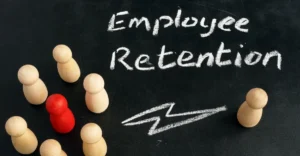
Farewell lunches, exit interviews, online group farewell cards and other departure rituals are often treated as informal gestures at the very end of employment – if they are addressed at all. However, a growing body of research suggests that how organisations handle departures has measurable effects on team morale, employer branding and even retention among employees who stay.
While onboarding has been studied and optimised for years, offboarding remains one of the least developed stages of the employee experience. This is despite strong evidence that last impressions can be just as influential as first ones, and that seemingly small practices, such as group leaving cards used by teams, or a farewell email from the group, can play a meaningful role in how departures are perceived by both departing employees and those who remain.
Offboarding Is a Social Signal, Not Just an Administrative Step
Recent research by Coulon et al. (2025) highlights a critical oversight in many organisations: while onboarding tends to strengthen organisational identity, offboarding often weakens it, not only for the employee leaving, but for everyone observing the departure.
Across two studies, Coulon et al. found that employees who experienced or witnessed high-quality offboarding reported up to 75% stronger organisational identification compared to those who experienced poorly handled exits. This effect applied both to departing employees and to colleagues who remained.
In practical terms, farewell moments function as social signals. When teams pause to acknowledge someone’s contribution through shared messages or a coordinated team farewell, they reinforce a shared sense of “who we are” as an organisation rather than allowing it to erode.
This matters because organisational identification influences how former employees speak about the organisation, both online and offline, whether they return as collaborators or “boomerang” hires, and how remaining employees feel about their own future with the company.
Why Observed Farewells Shape the Remaining Workforce
One of the most overlooked findings in offboarding research is the impact of departures on employees who stay.
Coulon et al. (2025) found that employees who witnessed higher-quality offboarding reported:
- stronger organisational identification
- higher psychological safety
- greater job satisfaction
- more organisational citizenship behaviours
This explains why seemingly small rituals matter. A group leaving card or shared farewell drinks, for example, are rarely about the person exiting alone. They are visible signals to the remaining team that contributions are recognised and that people will be treated with dignity at key transition points.
Over time, repeated experiences of poorly handled exits can quietly undermine trust and increase disengagement, even among high performers with no immediate intention to leave.
Employer Brand Is Often Defined at the Exit
No matter how positive an employee’s experience was during their time at a company, the departure often becomes the lens through which everything else is remembered.
Qualitative research by Gruber (2023) shows that offboarding experiences directly shape employer branding, particularly through word of mouth and online reviews. Departing employees who experienced broken psychological contracts, lack of appreciation or poor communication were significantly more likely to share negative feedback than positive experiences.
Crucially, Gruber’s findings also show that negative exit experiences are shared more frequently and more widely than positive ones, especially in small and medium-sized organisations where personal networks carry greater weight.
At the same time, the research highlights that even minor actions, such as transparent communication or visible appreciation, can meaningfully improve how an employer is perceived after departure.
Manager Behaviour Sets the Tone for Farewell Experiences
Gallup’s 2024 research reinforces that exit experiences are shaped far more by human interaction than by policy. In their study of voluntary leavers, the following has been found:
- only 43% were satisfied with how their exit was handled
- 24% experienced rudeness, hostility or negativity from their manager
- employees who felt supported were 2 times more likely to be satisfied with their exit experience
Gallup also found that employees who were extremely satisfied with their exit were:
Related Posts
- 43% more likely to recommend their former employer
- six times more likely to consider returning as a boomerang employee
Structured farewell moments, such as coordinated team send-offs or group leaving cards, give managers a practical way to demonstrate support, even when a departure is unavoidable.
Farewells, Social Capital and Long-Term Value
Offboarding is not only about emotion; it is also about continuity.
Research summarised by Gruber (2023) highlights that poorly managed exits lead to the loss of social networks and company knowledge base. In many sectors, particularly those that rely heavily on relationships and collaboration, such as law, consulting or professional services, this loss carries real long-term costs.
Farewell rituals create space for reflection, knowledge sharing and relational closure. When teams intentionally mark a departure, they are more likely to extract learning, preserve goodwill and maintain alumni relationships that can later support referrals, rehires or future collaboration.
How Employers Can Improve the Leaving Experience
Across studies, one insight is consistent: offboarding quality does not depend on complexity or cost.
What matters most is:
- recognition
- transparency
- respect
Gallup (2024) notes that one of the most common examples of a poor exit experience is simply forgetting an employee’s final day.
In contrast, even small actions, such as marking departures in team calendars or remembering to sign a farewell card or send a short team message over email or Slack, can meaningfully improve how the experience is perceived.
Effective practices include:
- acknowledging departures publicly
- encouraging managers to express support and appreciation
- facilitating collective participation in farewells
Gallup (2024) have suggested that 40% of voluntary leavers felt proud of their work, but leavers who feel proud of their work are more likely to feel like they have had a positive experience with their employer. This means that encouraging praise and positive feedback on the employee’s achievements from managers will help with a positive farewell outcome.
Group leaving cards and team farewell messages are effective precisely because they allow multiple people to contribute, making shared appreciation easy. For hybrid and distributed teams, these collective digital rituals may be the only way to ensure inclusive and consistent farewell experiences.
Why Offboarding Matters for HR and People Leaders
Offboarding is an important ingredient of retention, despite sounding like it may be the opposite to it.
Evidence from organisational psychology, employer branding research and Gallup’s workforce studies all point to the same conclusion: how employees leave shapes how others stay. Farewell traditions, including collective gestures like group leaving cards, help organisations protect trust, preserve social capital and maintain long-term employee engagement.
In a labour market defined by mobility, the way teams say goodbye has never mattered more.