Ask a CHRO in late 2026 how their culture is holding up, and you’ll get a pause before the answer. Not because they don’t know. Because the honest answer is complicated, and most of them have stopped pretending otherwise.
Gartner surveyed 426 CHROs across 23 industries and four global regions this year and came back with a term for what a lot of HR leaders had already been circling in vaguer language for a while: culture atrophy. It’s one of four top priorities the firm identified for CHROs heading into 2026, sitting right alongside AI strategy and workforce planning for a blended human-AI workplace. Only 47% of CHROs now say their culture actually drives performance. Two years ago, that number was higher. It’s not a small drop, and it’s not isolated to one industry or region.
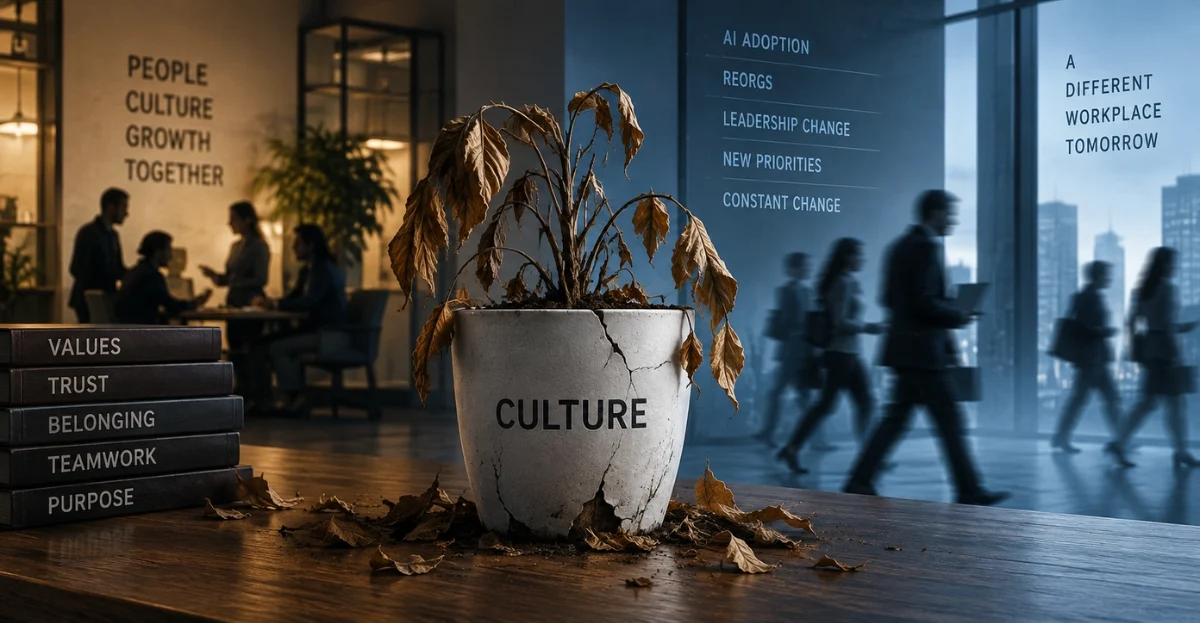
The uncomfortable part isn’t the erosion itself. Cultures have always drifted when nobody tends to them. What’s different this time is the pace. Reorgs, AI rollouts, leadership changes, and shifting priorities are no longer landing one at a time with room to absorb each one. They’re stacking. And when change stacks faster than culture can metabolize it, you get something HR researchers are now describing in almost the same words: change has become ungovernable.
What is culture atrophy, exactly?
Culture atrophy is the gradual weakening of the shared values, rituals, and behaviors that once made an organization function the way it was designed to. It’s not a single event. Nobody wakes up one Monday to a culture that’s collapsed. It happens in increments – a ritual that quietly stops happening, a value that turns into a slide in the onboarding deck instead of something people actually see leadership live out, a gap between what’s said in town halls and what’s experienced on the floor that keeps widening until people stop noticing it’s there.
By mid-2025, only 26.7% of employees said they genuinely believed in their organization’s culture. That’s down from 32% in 2022. Three years, and roughly a third of that belief just… left.
The word “atrophy” is doing real work here, and it’s worth sitting with for a second. Muscles atrophy when they stop being used, not when something dramatic breaks them. Culture atrophies the same way – through neglect, not through a single bad decision. Which is also why it’s so easy to miss until someone puts a number on it.
Why has change become ungovernable?
Here’s the mechanism, as best anyone can currently describe it.
For most of the last decade, organizations treated change as an event. You planned it, you ran it, you closed it out, and then things went back to something resembling normal. HR built entire playbooks around that assumption – change management as a project with a start and an end.
That assumption doesn’t hold anymore. AI adoption alone has forced most companies into a state of continuous change: new tools, new workflows, new questions about what a given role even means six months from now. Layer on restructuring driven by economic pressure, leadership turnover, and shifting go-to-market strategies, and you get an environment where there’s no “back to normal” to return to. There’s just the next change, arriving before the last one settled.
McKinsey’s research across more than 10,000 senior executives in 15 countries points at the same conclusion from a different angle: organizations now need to adapt continuously, not respond to isolated changes. That’s a structural shift, not a temporary rough patch. And it means the tools HR built for episodic change – the annual survey, the quarterly culture check-in, the once-a-year values refresh – are simply too slow for what’s actually happening.
You can see why “ungovernable” is the word people keep reaching for. Governance implies you can see the thing you’re governing clearly enough to steer it. When change is constant and overlapping, that visibility disappears. Leaders aren’t failing to manage change so much as they’re managing something that no longer holds still long enough to be managed in the old sense.
The signs most leaders miss
Culture atrophy rarely announces itself. It shows up sideways, usually in places that look like something else first.
Related Posts
Engagement scores hold steady while discretionary effort quietly drops – people show up, do the job, and stop doing the things nobody’s tracking. Onboarding starts taking longer to “click” because new hires can’t find the informal norms that used to get passed down naturally, since the people who’d normally pass them down are themselves stretched thin. Meetings about culture increase even as lived culture decreases – a strong signal that leadership has noticed something’s off and is talking about it more than they’re acting on it.
And there’s a subtler one: managers start treating people less like colleagues and more like resources to be reallocated. Robert Walters’ research on this found that 54% of UK professionals identified what they called “culture rot” as a significant problem where they work, and 81% of employers agreed that cost-cutting measures had meaningfully weakened their culture. Once people sense they’re being managed as a line item rather than a person, they tend to stop giving anything beyond what’s strictly required. It’s a rational response. It’s also very hard to reverse once it sets in.
What actually helps
None of this means culture is unmanageable – it means it needs to be managed differently than it was five years ago. A few things separate organizations that are holding their culture together from ones that aren’t.
Build for continuity, not events: If culture atrophy comes from treating change as episodic, the fix starts with treating culture maintenance as continuous instead. That’s frequent, short, high-quality check-ins between managers and employees rather than a once-a-year survey. It’s slower to set up and faster to catch problems.
Get leaders comfortable routinizing change instead of announcing it: Gartner’s own data found that when change becomes an instinctive part of how a team works, rather than a disruptive special event, the probability of healthy adoption roughly triples. That’s a leadership skill, not an HR policy – which means it has to be built through how leaders actually operate day to day, not through a memo.
Close the say-do gap deliberately: If your stated values and your daily practices have drifted apart, the fix isn’t a rebrand. It’s picking the two or three places where the gap is widest – usually performance reviews, promotion decisions, or how bad news travels up the chain – and closing those first, visibly.
Watch AI’s effect on culture, not just productivity: How HR should prepare teams for AI agents working alongside them isn’t just a technology question anymore. It’s a culture question, because how people are asked to work alongside AI shapes whether they feel like partners in the change or subjects of it.
Rethink what leadership adaptation actually requires: A lot of the current thinking on this traces back to a shift in what “control” means for leaders navigating complexity – the idea that steering an organization through constant change looks less like command and more like adaptation, which is a harder skill to build than most leadership training accounts for.
The honest takeaway
Culture atrophy isn’t a crisis with a clean fix, and anyone selling you one is skipping the hard part. It’s a slow leak, and slow leaks get fixed by people who check the tires regularly, not by people who wait for the blowout.
The organizations that come out of this in decent shape probably won’t be the ones with the most polished values statement. They’ll be the ones whose leaders noticed the gap early, said so out loud, and kept closing it – one uncomfortable, unglamorous conversation at a time.