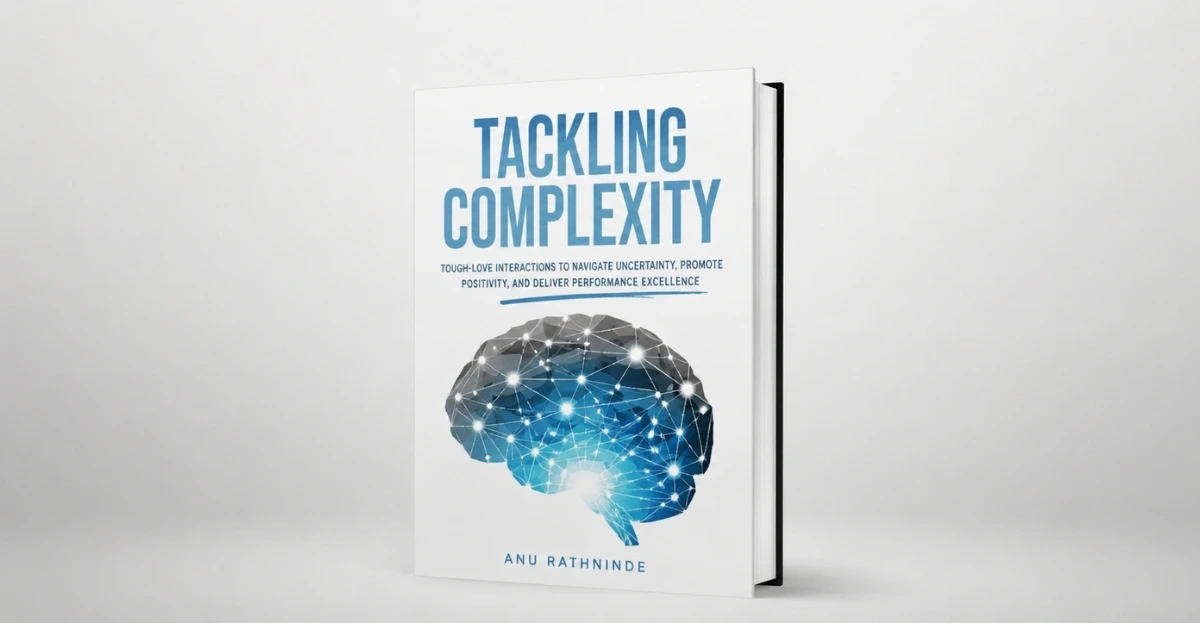
A Book Review of Tackling Complexity by Anu Rathninde
What happens when a carefully constructed business plan meets a world that refuses to behave according to plan? Markets shift, customers change, teams evolve, technology disrupts assumptions and decisions create consequences that no spreadsheet can fully predict.
This is the starting point for Anu Rathninde’s Tackling Complexity: Tough-Love Interactions to Navigate Uncertainty, Promote Positivity, and Deliver Performance Excellence. Rather than offering another formula for becoming a better leader, Rathninde challenges a more fundamental assumption: that organisations can be managed like machines.
His argument is compelling because it reflects a reality familiar to anyone who has led through change. People and organisations are living systems. They learn, respond, adapt and evolve. As a result, even a well-designed strategy cannot guarantee a predictable outcome.
From Control to Influence
One of the book’s strongest ideas is its critique of deterministic leadership—the belief that the right decision, strategy or intervention will produce the expected result. Rathninde illustrates this through business examples, including the Boeing 737 MAX crisis, showing how decisions made at one level can interact with pressures and behaviours elsewhere in an organisation.
The lesson is not to abandon planning. It is to stop confusing a plan with control.
For leaders, this is an important distinction. In a complex environment, the real leadership challenge is not simply deciding what should happen; it is understanding what is actually happening and responding before small issues become large failures.
The SIILA Model
At the heart of the book is the SIILA model: Systems Thinking, Internalize, Interact, Learn and Adapt.
The sequence is significant. Rathninde begins with systems thinking—understanding that departments, people, customers, suppliers and decisions are interconnected. He then turns the lens inward. Internalize asks leaders to understand their own motivations, values and behaviours before attempting to influence others.
Interact is where the model becomes particularly practical. Leaders are encouraged to move beyond the boardroom, cross organisational boundaries and engage with people at different levels. The objective is to discover what they do not know. That interaction creates learning, which then enables leaders to adapt.
In this sense, SIILA is not presented as a one-time leadership exercise. It is a loop. The organisation changes, the leader learns, behaviour changes, and the cycle begins again.
Related Posts
The Power of Tough Love
The book’s most distinctive contribution is perhaps its idea of “tough-love interactions.”
Tough love, in Rathninde’s framework, is not about being authoritarian or unpleasant. It is about caring enough to confront reality. Leaders need to “telescope” their organisations to look beyond the information that naturally reaches them, understand what is happening on the ground and address uncomfortable issues directly.
That idea has particular relevance to modern workplaces. Leaders can easily become insulated by layers of management, dashboards and filtered information. By the time bad news reaches the top, it may already be expensive to fix.
Rathninde’s answer is simple but demanding go and see, ask questions, listen, challenge assumptions and stay connected to the people doing the work.
Leadership Starts With the Leader
Another strength of the book is that it does not place the entire burden of complexity on organisational structures. Rathninde repeatedly brings the conversation back to self-leadership.
Before leaders can influence a complex organisation, they need to understand what drives them, what values they are unwilling to compromise and what habits shape their decisions. The book’s emphasis on mastering oneself makes the leadership discussion more personal and, in many ways, more uncomfortable.
The book is not a quick read in the conventional business-book sense. Its concepts require reflection, particularly for readers unfamiliar with systems thinking and complexity theory. But that is also part of its value: it asks readers to slow down and reconsider some assumptions that are often treated as standard leadership practice.
A Book for Leaders Living With Uncertainty
Tackling Complexity is ultimately not a book about eliminating complexity. It is about becoming a leader who can function effectively within it.
Its most useful message is that uncertainty is no longer an occasional disruption to leadership; it is the environment in which leadership increasingly takes place. The leaders who thrive will therefore not necessarily be those with the most detailed plans, but those who can observe, question, learn and adapt continuously.
For CEOs, business heads, functional leaders and managers navigating change, silos and shifting expectations, Tackling Complexity offers a valuable reminder: when the world refuses to follow the manual, leadership begins with knowing how to operate without one.