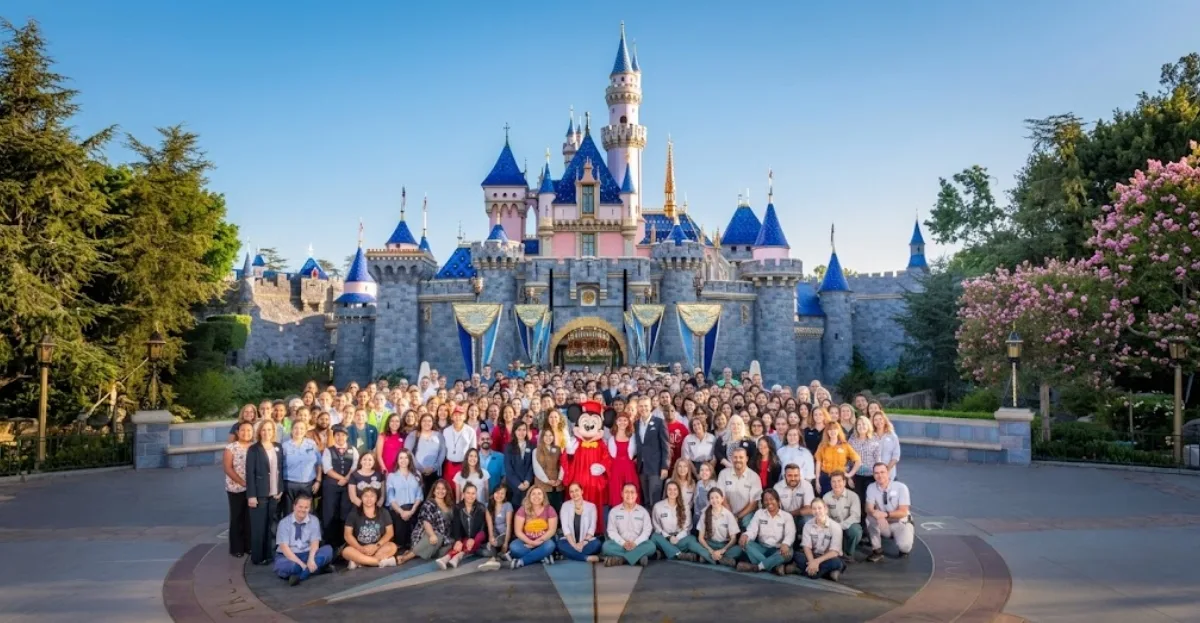
Image Courtesy: https://www.benefitnews.com/news/disney-offers-additional-learning-benefits-to-employees
Ask anyone who has worked a shift at a Disney park and they will tell you the same thing: the smile is not an accident. It is trained, reinforced, recognized, and occasionally exhausting to keep up on a 95-degree afternoon in Orlando. Disney employee experience is one of the most studied case files in HR because the company figured out something most organizations still struggle with – culture only sticks when it is designed into the job itself, not bolted on with a poster in the break room.
Walt Disney built this philosophy from the start. He believed the people creating the experience mattered as much as the experience itself, and that idea shaped everything from how Disney hires to how it trains, recognizes, and eventually promotes its workforce. This piece looks at how that plays out in practice – the onboarding, the frameworks, the perks, and the parts that don’t make it into the brochure.
Every employee is a cast member, and that’s not just branding
Disney doesn’t call its people “staff.” They are cast members, working in “roles,” on a “stage,” in front of “guests.” Even senior executives use this language. It sounds like marketing until you realize what it does structurally: it tells every person, from the chef prepping onions to the ride operator to the finance director, that they’re part of the same production. The vocabulary is a constant, quiet reminder that the job is performance and hospitality combined, not just a task list.
This matters for employee experience because language shapes identity. A “staff member” clocks in and out. A “cast member” is part of a story that continues whether or not they’re on shift.
Traditions: the first day sets the tone for the whole career
Before a new hire ever sets foot on a park floor, they go through Traditions – a required orientation held at Disney University, a training institution Walt Disney set up before Disneyland even opened. Every employee attends, regardless of level or role. It typically runs four to eight hours and covers company history, the Disney “heritage,” appearance standards, and a guided walk through the parks, including the underground utilidors that guests never see.
The class is facilitated by cast members themselves, often people who volunteer for the role because they enjoyed their own Traditions experience. New hires leave with an official name tag and a photo, usually with a familiar mouse-eared character. It’s a small ceremony, but it marks the moment someone stops being a job candidate and becomes part of the cast.
After Traditions, employees move to role-specific and location-specific onboarding – for example, EPCOT’s new hires spend a day learning about the cultural context of the pavilions they’ll work in. The layered approach means culture training happens before task training, not instead of it.
The keys that guide every interaction
Disney trains cast members around a small set of standards, historically known as the Four Keys – Safety, Courtesy, Show, and Efficiency – with Inclusion added as a fifth key in 2021. Safety comes first in every scenario: a guest’s experience never outranks their well-being.
Courtesy and Show cover the hospitality and performance elements. Efficiency keeps operations running without guests noticing the machinery behind them. Inclusion was formalized to make explicit what cast members are expected to model toward guests and each other.
The value of a framework this simple is that it’s usable in the moment. A ride operator deciding how to handle a guest who’s upset doesn’t need a policy manual – they need a hierarchy they’ve memorized. That’s a lesson that travels well beyond theme parks: values only function as culture when they’re short enough to recall under pressure.
Growing cast members instead of just hiring them
One of the more distinctive parts of Disney’s employee experience is Disney Aspire, an education benefit built with the learning platform Guild. Since its 2018 launch, the program has helped roughly 14,000 employees pursue everything from a high school diploma to a master’s degree, with the company covering tuition upfront.
Disney has said that access to Aspire is one of the top reasons applicants cite for wanting an hourly role in the first place, and thousands of participants have been promoted into leadership positions after using it.
The program isn’t static. In 2024, Disney introduced an annual funding cap on tuition assistance and phased out enrollment in some graduate and trade-school tracks, a change that drew visible frustration from cast members online.
It’s a useful reminder that even a widely praised benefit gets adjusted when it collides with budget realities – and that employee experience is something companies actively manage and renegotiate, not a fixed achievement.
Recognition that goes beyond a certificate
Disney runs a layered set of recognition programs rather than one annual awards night. The Disney Legacy Award and Disney Legends program honor long-term, high-impact contributions. The RAVE Award and the Environmental Excellence Award recognize specific behaviors. On social media, guests can tag a cast member using #CastCompliment, and a supervisor will often repost it with the employee’s name and photo attached.
What stands out is the mix of top-down and peer-to-peer recognition. A formal award from leadership carries weight, but a guest’s public shout-out reposted by a manager does something different – it turns recognition into a visible, ongoing conversation rather than a once-a-year event.
Perks that reduce friction, not just reward loyalty
Alongside pay, eligible cast members get complimentary park access, a Disney+ subscription, merchandise and dining discounts, and invitations to previews and events. These aren’t reserved for tenure milestones – many kick in early, which matters because it lets employees experience the product they’re selling to guests every day. A ride operator who has actually taken their kids through the park they work at sells the magic more convincingly than one who hasn’t.
Related Posts
Where the story gets more complicated
No honest look at Disney employee experience should skip the parts that don’t photograph well. Cast members have organized and negotiated over wages that many said didn’t keep pace with the cost of living near Orlando and Anaheim. Seasonal and part-time roles, which make up a large share of the frontline workforce, come with less schedule stability than the culture messaging might suggest. And the 2024 tuition cap is one example of a benefit tightening after years of expansion.
None of this erases what Disney does well in onboarding, training, and recognition. But an employee experience built on emotional labor – smiling, performing, absorbing guest frustration for eight-plus hours – has real costs, and Disney’s own workforce has been vocal about where the trade-offs sit. A credible case study includes that tension instead of editing it out.
What HR leaders can take from Disney’s approach
You don’t need a 40,000-employee theme park to apply the underlying ideas.
Front-load culture, not just paperwork. Disney puts Traditions before job training. Most companies do it the other way around, and culture ends up feeling like an afterthought bolted onto week three.
Keep your values short enough to use under pressure. Five keys is memorable. A forty-page values deck isn’t.
Treat learning and development as retention infrastructure. Aspire didn’t just help individual employees – it became a recruiting draw, cited by a quarter of applicants for hourly roles. Development benefits pay for themselves in ways that are hard to see on a single line item but show up in turnover data.
Make recognition visible and frequent, not just formal. A manager reposting a guest compliment costs nothing and does more for morale than a plaque handed out once a year.
Be honest about the cost of the culture you’re asking people to perform. If the job involves sustained emotional labor, pair it with real wage growth and schedule predictability, not just perks.
Frequently asked questions
What is Disney’s employee experience actually built on?
It rests on structured onboarding through Traditions and Disney University, a short set of behavioral standards called the Keys, ongoing recognition programs, and benefits like Disney Aspire that link education to career growth.
What are the Keys Disney trains its employees on?
Safety, Courtesy, Show, and Efficiency were the original four; Inclusion was added as a fifth key in 2021 to make expectations around equity and belonging explicit.
What is Disney Aspire?
It’s Disney’s education benefit, launched with Guild in 2018, that helps eligible hourly and part-time employees pursue high school diplomas through graduate degrees. Disney introduced an annual funding cap and reduced program enrollment in 2024.
Why does Disney call employees “cast members”?
The term reinforces that every role, on stage or behind the scenes, contributes to a shared guest experience. It’s part of the company’s broader “show business” framing of hospitality work.
Is the Disney employee experience only positive?
No. Cast members have publicly raised concerns about wages, scheduling stability for part-time roles, and benefit changes like the 2024 tuition cap. The training and recognition systems are strong, but they don’t eliminate the real trade-offs of frontline hospitality work.
Disclaimer: This article is for informational purposes only. While efforts are made to ensure accuracy, readers should verify information and seek professional advice as needed.