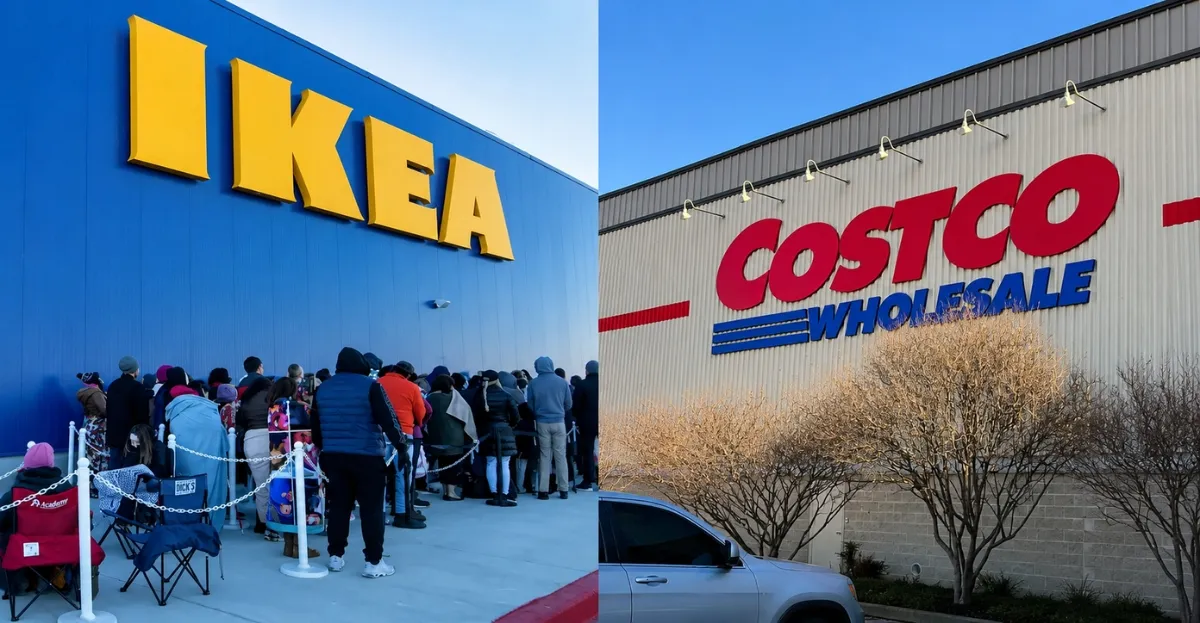
Image Courtesy: https://www.sfgate.com/food/article/Review-Ikea-vs-Costco-which-serves-better-13634346.php
Every year, a handful of retailers get named in the same breath as “great employers,” and IKEA and Costco are two of the ones that keep showing up. Both run frontline-heavy, hourly-wage businesses. Both fight the same retention war every other retailer fights. And both have found a way to win it, using almost completely different playbooks.
Costco bets on money. Pay people more than the market thinks is rational, and the payroll bill turns into a retention machine. IKEA bets on belonging. Build a culture people don’t want to leave, and pair that with real internal mobility, and the wage line matters a little less.
Neither approach is copy-paste for every business. But if you run a company where frontline turnover is quietly eating your margins, there’s something to learn from both.
Costco: Pay People Well, Keep Them for Decades
Costco’s people strategy isn’t complicated to describe. It’s just unusually hard for most retailers to actually do, because it costs money upfront and the payoff shows up slowly.
Here’s the shape of it in 2026:
- Entry-level pay starts at $19.50–$20 an hour, well above the retail norm.
- Top-of-scale senior clerks earn $31.90 an hour, with a further $1 raise locked in under the current labor agreement through March 2027.
- Employees get 1.5x pay on Sunday shifts.
- After six years of full-time service, workers become eligible for semiannual bonus checks, starting around $5,500 a year and rising toward $10,000 for employees with 25 years in.
- Health coverage kicks in relatively fast, and Costco’s 401(k) match has left “many thousands” of hourly employees with seven-figure retirement accounts, according to reporting in the Wall Street Journal.
The result shows up in the retention numbers. Costco’s one-year employee retention rate sits around 93%, and annual turnover for staff with more than a year of tenure runs somewhere between 6% and 8%. Compare that to a retail industry average that’s typically cited at 60–70%, and you start to see why Costco’s model gets studied so much. Average tenure across the company is about 4.6 years, well above the roughly 3.4-year retail norm.
MIT Sloan management professor Zeynep Ton has pointed to Costco as a textbook case of what she calls a “good jobs strategy”: paying more, training more, and cross-training staff so stores can run with fewer people covering more ground without falling apart during a rush. The logic isn’t charity. It’s that a warehouse full of five-year veterans who know the floor, the members, and each other simply runs better than a warehouse that’s constantly retraining new hires.
CFO Gary Millerchip has been candid that the wage increases create real pressure on the company’s cost structure. But Costco bets that the money saved on recruiting, training, and lost productivity from constant turnover more than makes up for the higher payroll. Nearly all of Costco’s CEOs, including current CEO Ron Vachris, started on the warehouse floor. Vachris began as a forklift driver in 1982. That’s not a talking point pulled from a careers page; it’s a hiring pipeline built over four decades.
What Costco’s model is actually optimizing for: stability and depth of experience on the floor, funded by industry-leading pay.
IKEA: Culture, Flexibility, and a Career Path for “the Many”
IKEA’s approach starts from a different question. Instead of “how do we make the pay so good that people don’t leave,” it asks “how do we make the day-to-day experience good enough that pay isn’t the main reason people stay or go.”
That shows up in a few concrete ways:
Related Posts
- Full-time benefits eligibility starts at just 20 hours a week – a lower bar than most retailers set.
- Health care eligibility typically kicks in within about 15 days of starting.
- Parental leave runs up to 16 weeks, available to both mothers and fathers, and extends further for co-workers with several years of tenure.
- A 15% co-worker discount on furniture and food starts from day one – and continues for life for anyone who retires after ten-plus years with the company.
- The “Tack!” program adds extra pension contributions for long-serving co-workers, applied equally regardless of role or salary.
- Every new hire is paired with a “buddy” for onboarding, on top of formal training and leadership development programs for anyone who wants to grow within the company.
IKEA’s HR leadership has talked openly about treating long-tenured staff as “anchors of culture” who mentor newer hires, rather than simply as people waiting to be replaced. During and after the pandemic, IKEA moved shift scheduling online and let employees swap shifts without needing manager sign-off – a small operational change that removed a lot of the friction that normally pushes hourly retail workers out the door when life gets unpredictable.
The company has also leaned into something less common in retail HR: building actual employee personas. One internal initiative broke IKEA’s workforce down into segments – young part-timers, brand loyalists turned employees, retirees supplementing income – and tailored benefits communication to what each group actually needed, rather than sending everyone the same generic memo. Where IKEA applied that approach, headcount grew 31% and engagement scores rose more than 20%, according to internal data IKEA has shared publicly.
IKEA doesn’t try to out-pay Costco, and it doesn’t pretend to. Instead, it competes on flexibility, inclusion programs – including co-worker resource groups for different communities – and a career path that turns entry-level roles into decades-long employment for people who want it.
What IKEA’s model is actually optimizing for: belonging and internal mobility, funded by scheduling flexibility, fast benefits access, and a culture that treats tenure as an asset rather than overhead.
Where the Two Models Actually Diverge
| Costco | IKEA | |
| Core lever | Above-market pay and bonuses | Culture, flexibility, and mobility |
| Retention driver | Compensation ceiling that keeps rising with tenure | Fast benefits access, scheduling control, belonging |
| Signature policy | Sunday premium pay, six-year bonus eligibility | 20-hour benefits threshold, lifetime retiree discount |
| Leadership pipeline | Nearly all senior leaders started on the floor | Structured internal training and mobility programs |
| Approx. 1-year+ turnover | ~6–8% | Not separately disclosed at the same granularity, but positioned as a top-decile retail retainer |
| Biggest strength | Deep bench of experienced, well-paid staff | Workforce that feels genuinely invested in, not just paid |
| Biggest risk | Payroll costs rise faster than margin if growth slows | Culture commitments can feel thin if flexibility promises aren’t kept locally |
Both companies are chasing the same outcome – a workforce that sticks around long enough to get good at the job and cares enough to make the customer experience better. They’re just funding that outcome from two different line items on the P&L: one from compensation, one from culture and benefits design.
What This Actually Means If You’re Building a Retail or Frontline Culture
Most companies reading this aren’t going to out-pay Costco, and that’s fine – very few businesses can carry Costco’s margins or its scale. The more useful exercise is figuring out which lever you actually have room to pull.
A few things worth taking from both models, regardless of your size:
- Money buys patience, but not loyalty on its own: Costco’s pay ceiling works because it’s paired with real bonuses, real benefits, and a visible path to more money over time – not a single generous starting wage that plateaus.
- Flexibility is cheaper than it looks and matters more than most leaders assume: IKEA’s shift-swapping change cost almost nothing to implement and directly addressed one of the top reasons hourly workers quit: unpredictable scheduling colliding with real life.
- Tenure should be treated as an asset on the org chart, not just in a mission statement: Both companies visibly promote from within and use long-tenured staff to train new hires. That’s a structural choice, not a slogan.
- Pick the lever that matches your actual constraints: If your margins can absorb higher wages, Costco’s model gives you a fairly direct playbook. If cash is tighter but you can offer schedule control, faster benefits eligibility, or a genuine growth path, IKEA’s model shows that culture and flexibility can do real retention work too.
Neither Costco nor IKEA got here by accident, and neither treats its employer brand as separate from its business model. That’s really the throughline: the companies that get retail retention right don’t bolt culture on top of the business – they build it into how the business runs day to day.
Disclaimer: This article is for informational purposes only. While efforts are made to ensure accuracy, readers should verify information and seek professional advice as needed.