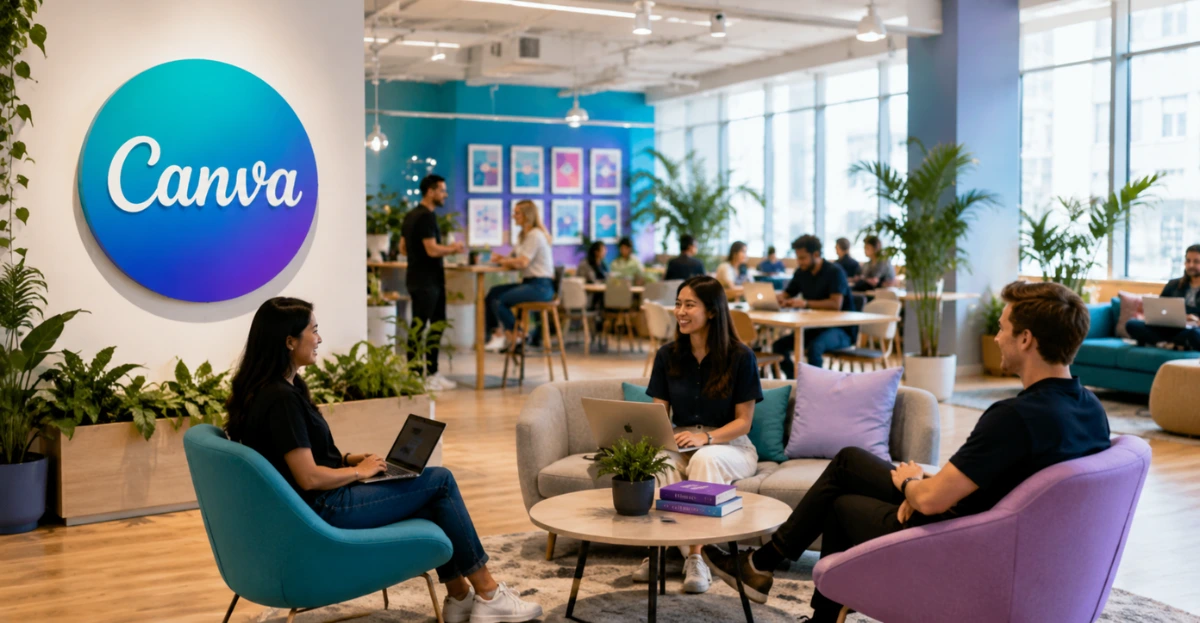
Canva started in a family living room in Perth in 2013. It now has thousands of employees – Canvanauts, in the company’s own language – spread across time zones, and a design platform used in more than 190 countries. Somewhere in that jump from side project to global company, Canva also became one of the more studied examples of deliberate employer branding, not by accident.
Canva workplace culture gets referenced a lot in HR and talent circles, but most of the coverage stops at the perks list: free snacks, equity, volunteer days. That’s the surface. The more useful question for anyone building an employer brand is how those pieces connect – how a two-line strategy statement, a product habit, and a pay structure ended up reinforcing each other well enough to hold together while the company scaled from eight people to a multinational workforce.
This piece looks at four parts of that system: the Two-Step Plan that sets the tone for everything else, the design-thinking habits borrowed from the product team and applied to how people work, the ownership structure that ties employees to outcomes, and the remote-first practices that let a company headquartered in Australia function as one team across the globe.
The Two-Step Plan: A Business Strategy That Doubles as a Culture Statement
Co-founder and CEO Melanie Perkins has described the company’s direction in two parts since its earliest days: build one of the world’s most valuable companies, then use that success to do as much good as possible. Canva calls this the Two-Step Plan, and it isn’t just marketing copy – it shows up in how the company frames internal wins.
Every new subscription, every feature shipped, every team that adopts Canva is talked about internally as progress on both steps at once. That framing matters for employer branding because it gives employees a reason for their work beyond quarterly targets.
A support engineer fixing a bug or a designer shipping a template isn’t just helping the company grow; the same action is presented as fuel for the company’s giving programs, which include a pledge to donate a large share of founder equity through the Canva Foundation and ongoing commitments like Pledge 1%.
Whether or not every employee thinks about the Two-Step Plan day-to-day, it does something useful for recruiting: it gives candidates a story that’s bigger than the product, and it gives Canva a consistent answer to “why work here” that doesn’t change every time the company pivots strategy.
Design Thinking Applied to How People Work, Not Just What They Build
Canva is a design company, so it’s not surprising that design thinking shows up in its internal processes too. A few examples are worth pulling apart because they’re operational, not aspirational.
Customer Zero: Before a new product ships externally, Canva’s own team uses it first. This forces employees to experience Canva the way a customer would, catch friction points early, and build empathy for the end user into the product cycle rather than bolting it on at the end.
Hackathons and Fix Fests: Twice a year, the company runs remote-first hackathons where teams from across the business – not just engineering – work on new ideas outside their usual roles. One of Canva’s more visible product shortcuts reportedly started as an intern’s idea during one of these events; that intern later joined the engineering team full-time. Fix Fests serve a similar purpose but are aimed specifically at improving existing rough edges in the product.
Canva Pathways: Internal mobility is treated as a design problem too. The Pathways program is built to help employees move between roles and reskill, and it facilitated more than 200 internal moves in a recent year. That’s a direct answer to a common employer-branding weakness: companies that only hire externally tend to leak talent once employees hit a ceiling in their current role.
None of this is unique to Canva in isolation – plenty of companies run hackathons or internal mobility schemes. What’s notable is that Canva ties all of it back to the same design principle it applies to its product: iterate quickly, test with real users (in this case, employees), and treat feedback as an input rather than criticism.
Employee Ownership: Equity as a Cultural Signal, Not Just Compensation
Every Canva employee receives equity as part of their compensation, a policy the company frames as making Canva’s success shared success. This isn’t unusual for a venture-backed tech company, but two things about Canva’s approach are worth noting for anyone thinking about employer branding through ownership.
First, the scale of the liquidity events has been unusual for a private company. Canva has run secondary share sales that gave employees a chance to realize value from their equity without waiting for an IPO – a rare thing among late-stage private tech companies, and a meaningful trust signal when a company asks employees to hold equity for years.
Second, ownership at Canva is framed as tied to purpose, not just upside. The company’s Force for Good program gives every employee three paid volunteer days a year, plus a donation-matching scheme, explicitly linked back to the Two-Step Plan. The pitch to employees isn’t just “your equity might be worth more later” – it’s “your work funds both the business and the causes we’ve committed to.”
There’s a real tension worth naming here too, and any honest look at Canva’s employer brand should include it: compensation reviews of the company note that base cash pay is competitive but not top-of-market, and that equity value depends heavily on the company’s valuation at any given moment, which has fluctuated. Employee ownership is a genuine cultural asset, but it isn’t a substitute for cash certainty, and it works best for people willing to stay long enough to see it pay off.
Remote Collaboration: Coordinating a Global Team from an Australian Base
Canva’s founding team is Australian, but the workforce hasn’t stayed that way, and the company had to build remote-work muscle earlier than most. During the shift to pandemic-era remote work, teams across the company reportedly moved to fully remote operations within 24 hours of the announcement – not just logging in from home, but adjusting meeting cadences, offering internet and lunch stipends, and moving in-house fitness sessions online.
Related Posts
That early experience shaped how the company now structures work more permanently. Canva offers three categories – hybrid, permanent remote, and onsite – letting teams choose the setup that fits their work rather than forcing one model company-wide.
Supporting habits followed: a meeting-free block midweek to protect focus time, and more than 400 employee-led interest clubs that give remote and distributed staff a way to build relationships outside their immediate team.
The harder part of remote collaboration for a global employer brand is consistency – making sure a Canvanaut in Manila has roughly the same experience as one in Austin or Sydney.
Canva’s approach has been to treat values (the six stated ones include setting ambitious goals, empowering others, and pursuing excellence) as fixed across every region, while letting local teams adapt specific practices – holiday calendars, celebration styles, benefits delivery – to local context. Regional operations have also localized campaigns and content rather than exporting a single US or Australian template worldwide, which extends the same design-thinking habit of testing with real users to internal culture as well.
What Other Employer Brands Can Take From This
A few patterns repeat across all four areas above, and they’re the parts most transferable to companies that aren’t Canva:
- Tie the mission to something concrete employees can point to: The Two-Step Plan works because it’s two sentences, not a paragraph, and because progress against it gets reported the same way revenue does.
- Apply your product’s own methodology to your internal operations: Canva didn’t invent a separate “people process” framework – it reused Customer Zero thinking on itself.
- Make ownership mean something beyond a compensation line item: Equity paired with a giving structure reads differently to candidates than equity alone.
- Build remote practices around actual working patterns, not a single mandated policy: Offering hybrid, remote, and onsite as real choices – rather than a blanket rule – respects that different teams need different things.
None of this makes Canva’s culture universally “the best” – no single model is, and plenty of former employees have flagged real tradeoffs around pay progression and workload during high-growth periods. But as a case study in employer branding, Canva’s approach is consistent enough, and documented enough, to be genuinely useful for HR leaders and talent teams trying to build something similar from scratch.
Frequently Asked Questions
What is Canva’s Two-Step Plan?
It’s the company’s stated strategy: Step One is to build one of the world’s most valuable companies, and Step Two is to use that success to do as much good as possible, largely through the Canva Foundation and programs like Pledge 1%.
Does every Canva employee get equity?
Yes. Equity is a standard part of compensation across the company, and Canva has run secondary share sales that have allowed employees to access liquidity before any public listing.
Is Canva a remote-first company?
Canva offers three working models – hybrid, permanent remote, and onsite – and lets individual teams choose the setup that fits their work, rather than mandating one policy company-wide.
What does “design thinking” mean inside Canva’s culture, as opposed to its product?
It shows up in practices like Customer Zero (employees test new features before customers do), regular hackathons open to the whole company, and an internal mobility program that treats career growth as something to be iterated on, not fixed.
Disclaimer: This article is for informational purposes only. While efforts are made to ensure accuracy, readers should verify information and seek professional advice as needed.