But the best pre-employment assessment tools can forecast the performance of candidates and how long they will last in your specific roles, not the ones that have the longest test catalog. The best platforms in 2026 will include 4 elements: assessments grounded in validated science, clear connection to the job being filled, a short experience that candidates will complete, and results that a hiring manager can act on within minutes.
From there, the option you select will depend on the type of work you are going to pay for. A company with hundreds of hourly positions may need something different than one hiring software engineers in five countries, or salespeople who need to meet quota in the first quarter. Some are designed around an employer’s own roles and top performers, some provide a pre-processed score in one sitting, some evaluate candidates in a simulated working environment, and some are designed for secure testing at a global scale.
This guide reviews five of the most popular pre-employment assessment tools, illustrates the main approaches, compares them side by side, maps them to typical hiring requirements, and explains how to determine whether an assessment helps you improve your hires when it is in place.
Four Approaches to Pre-Employment Assessment
Most pre-employment assessment tools fall into one of four approaches. Knowing which approach fits your hiring problem narrows the field faster than comparing feature lists, because tools within the same approach tend to share the same strengths and blind spots.
| Approach | How It Works | Strongest When | Main Trade-Off |
| Personalized assessments | Psychologists build an assessment around each role, often benchmarked on the employer’s own top performers | Turnover or performance problems are specific to your roles and culture | Needs some input from your team before launch |
| Combined-score assessments | One session measures several areas, such as ability and personality, and returns a single fit score | You want a fast, consistent ranking across many roles | Benchmarks come from general job profiles, not your workforce |
| Job simulations | Candidates complete sample tasks from the job, scored against a model answer | Hands-on skills matter more than traits | Each simulation takes time to design and to complete |
| Psychometric and proctored libraries | Large catalogs of standardized tests with strong security controls | You test at high stakes or across many countries | Standard tests need local checking to confirm they predict success in your roles |
These approaches aren’t mutually exclusive. Many employers pair a personalized or combined-score assessment for behavior and fit with a simulation or skills test for technical roles. The five tools below each lead with one approach.
The 5 Best Pre-Employment Assessment Tools in 2026
1. HighMatch
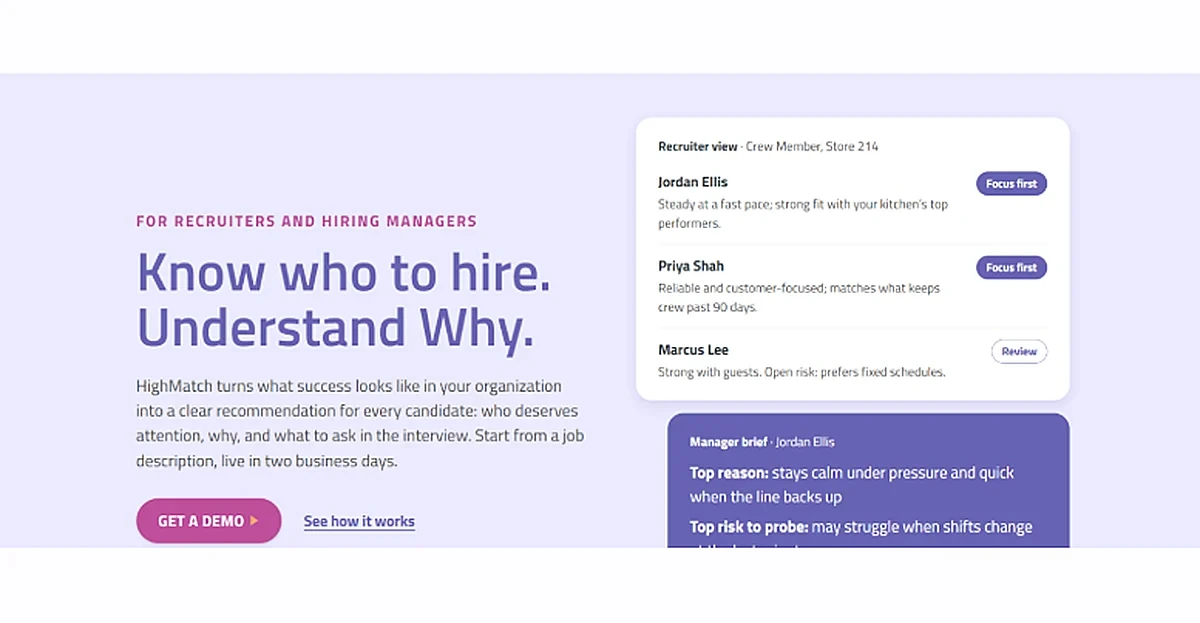
HighMatch turns what success looks like in an employer’s own roles into a clear recommendation for every candidate: who deserves attention, why, and what to ask in the interview. Its I/O psychologists build an assessment for each role, from hourly crew members to executives, rather than sending every candidate the same generic test.
What It Measures: Personality, aptitude, culture fit, emotional intelligence, hard skills and situational judgment, plus minimum qualification screeners and realistic job previews. Employers combine the measures that matter for each role.
What Hiring Teams Get: Recruiters see which candidates to focus on first, with the top reason and any open risk. Hiring managers get a two-minute interview brief with the top reason to move forward, the top risk to probe, and the questions to ask. HighMatch then compares its recommendations with how hires actually perform and refines the assessment over time.
Proof Points: HighMatch publishes results across very different roles.
- Momentum Solar was seeing a 25% close rate and early training dropouts among in-home sales reps. After HighMatch benchmarked its top reps, high-scoring hires generated 185% higher sales and installed nearly three times as many projects.
- Chopt Salad Company is featured in a HighMatch case study reporting hires who were 70% more likely to be retained.
- Gateway Engineers saw a 55% increase in performance.
- Bedel Security faced more than 5,000 applicants for four open roles and saved over 1,200 recruiter hours by focusing on best-fit candidates first.
HighMatch integrates with applicant tracking systems including Workday, iCIMS, Greenhouse, Lever, UKG, Oracle, SAP, Paylocity, and Paycor. It is rated 4.8 out of 5 on G2 and ranked first for enterprise relationships in G2’s Fall 2026 Talent Assessment reports.
Trade-Offs: Pricing is by quote. The deepest validation (Peak) depends on the employer sharing performance or retention data, so its full benefit builds over one or two hiring cycles.
2. Wonderlic
Wonderlic draws on 85 years of workplace assessment science, and its Wonderlic Select assessment measures cognitive ability, personality and motivation in a single session. Wonderlic frames the three areas as whether a candidate can do the job, how they will do it, and whether they want to.
What It Measures: Each role is pre-benchmarked against a jobs engine of more than 3 million job profiles, so employers can start without building their own benchmark. Results arrive as a ranked score with trait breakdowns and suggested interview questions.
Candidate Experience: Candidates take the assessment on any device with no app download.
Proof Points: Wonderlic reports that strong-fit hires show about 50% lower termination rates than moderate-fit hires, and that it has administered more than 200 million assessments for over 3,000 companies.
Integrations and Setup: Assessments can trigger automatically at a set hiring stage in Greenhouse, Lever, Workday, and iCIMS, and Wonderlic describes implementation as same-day.
Trade-Offs: Benchmarks reflect general job profiles rather than an employer’s own top performers. Pricing isn’t published.
3. Vervoe
Vervoe, based in Melbourne, Australia, tests candidates on sample work from the actual job instead of asking about traits. A customer support candidate might answer a support ticket, while an analyst might work through a spreadsheet task.
What It Measures: Practical skills, through video answers, written responses, coding challenges, multiple-choice, and interactive simulations set in tools such as a ticket queue or CRM. An AI Assessment Builder drafts a test from a job description for the hiring team to edit.
What Hiring Teams Get: Vervoe’s machine learning models grade and rank responses, learn from how the hiring team scores, and trace each score back to the task behind it. About 120 days after a hire, Vervoe checks performance and feeds it back into the skills it tests.
Integrity: Vervoe flags copy-paste, tab switching, and AI-written answers, matches a government ID to a live selfie, and has its AI audited for bias each year.
Trade-Offs: AI grading needs time to learn a team’s marking style, and pricing isn’t public. Simulations take candidates longer than a short behavioral assessment, which matters for high-volume roles.
4. Mercer | Mettl
Mercer | Mettl delivers more than 12 million assessments a year for over 6,000 clients across about 100 countries. It suits employers that hire at high stakes or across several countries and need strong security around every test.
What It Measures: A library covering more than 300 skills, including psychometric, personality and behavioral tests, cognitive aptitude, domain knowledge, AI-assisted coding, communication, situational judgment and spoken English.
Integrity: AI-assisted proctoring, human proctoring for high-stakes exams, browser lockdown, and three-point candidate authentication. Gartner has named Mercer | Mettl a Leader in remote proctored examinations, and the platform holds ISO 27001 certification.
Integrations: Candidates can be invited from major applicant tracking systems, including Greenhouse, with reports viewable inside the ATS.
Trade-Offs: The platform’s breadth may be more than a single-site or hourly hiring team needs, and standardized tests should be checked against local performance data. Pricing is by quote.
5. Thomas International
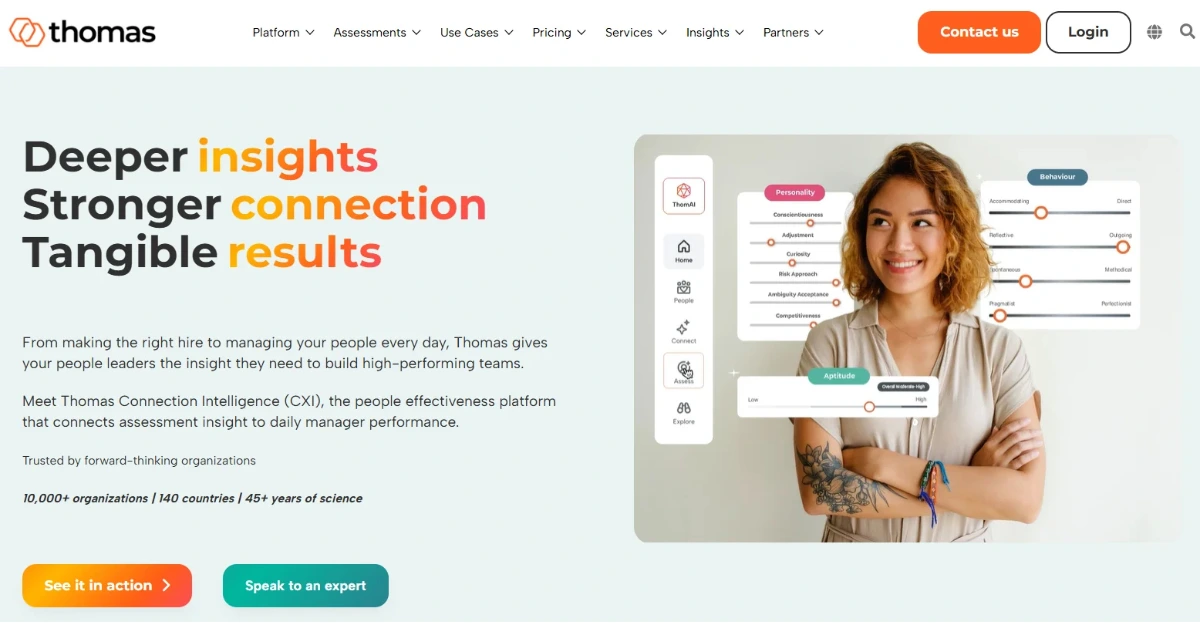
Thomas International has more than 40 years of psychometric experience and says its assessments are used by over 11,000 companies. Its assessments are registered with the British Psychological Society and meet EFPA standards.
What It Measures: Four core assessments: Behavior (how people naturally act at work), Aptitude through the General Intelligence Assessment (GIA), Personality through the High Potential Trait Indicator (HPTI), and Emotional Intelligence through the TEIQue.
What Hiring Teams Get: Instant results that can be compared with role profile benchmarks, and data that carries into onboarding, development, and team building after the hire.
Pricing: Thomas is one of the few providers with a published starting point: unlimited assessments from £5,000 a year for a small business account.
Trade-Offs: The assessments are standardized rather than built around one employer’s roles, and pricing is in pounds sterling, which US buyers should confirm when requesting a quote.
Matching Pre-Employment Assessment Tools to Your Hiring Needs
The same tool can be right for one team and wrong for another. This table maps common hiring situations to the assessment approach that tends to work best and the tools in this guide that fit.
| Hiring Situation | What to Measure | Approach That Fits | Tools to Consider |
| Hourly and frontline roles with early turnover | Reliability, fit with the shift and role, realistic expectations | Personalized assessment with a screener and job preview | HighMatch |
| Sales roles with uneven quota attainment | Traits shared by your top performers | Personalized assessment benchmarked on top reps | HighMatch, Wonderlic |
| Customer support and operations | Practical skills plus behavior under pressure | Job simulation combined with a behavioral measure | Vervoe, HighMatch |
| Software and technical roles across countries | Coding and domain skills, with strong anti-cheating | Proctored skills library | Mercer | Mettl, Vervoe |
| Graduate and early-career hiring | Learning speed and potential | Cognitive and personality assessment | Thomas International, Wonderlic |
| Managers and leaders | Judgment, emotional intelligence, leadership traits | Personalized or psychometric assessment | HighMatch, Thomas International |
Two patterns stand out. Where the problem is specific to your organization, such as people leaving a particular role in the first 90 days, an assessment built around that role usually outperforms a general benchmark. Where the problem is proving a skill, such as writing working code or handling a customer complaint, a simulation or proctored skills test gives more direct evidence than any personality measure.
How to Tell If Your Pre-Employment Assessment Tool Is Working
Buying a pre-employment assessment tool is the start, not the finish. Six metrics show within a few months whether the tool improves hires or just adds a step.
| Metric | What It Tells You | Warning Sign |
| Completion rate | Whether candidates finish the assessment | A sharp drop compared with the application stage, especially on mobile |
| Pass-through rate | How many candidates the assessment screens out | Almost everyone passes (it isn’t filtering) or almost no one does (the cut-off is too strict) |
| Performance by score band | Whether high scorers perform better on the job | No clear gap in manager ratings or productivity between top and bottom bands |
| 90-day retention by score band | Whether the assessment predicts who stays | High scorers leave at the same rate as low scorers |
| Adverse impact ratio | Whether pass rates are fair across candidate groups | A group’s pass rate below 80% of the highest group’s, the four-fifths rule in the federal Uniform Guidelines |
| Hiring manager use | Whether results shape interviews and decisions | Managers skip the report or ignore the suggested questions |
Score-band comparisons need enough hires to be meaningful, so small teams may need to combine several months or roles. Vendors that validate against an employer’s own outcomes, such as HighMatch with its Peak option and Vervoe with its post-hire performance check, do part of this analysis for you.
Mistakes That Undermine Pre-Employment Testing
- Testing for traits the job doesn’t need: Every measure should link to a documented part of the role.
- Stacking too many tests: Each extra test adds time and drop-off without always adding new information.
- Using one cut score for every role: A threshold that suits a sales role can screen out good candidates for an operations role.
- Treating the score as the decision. Assessments work best when they guide the interview, not replace it.
- Never revisit the setup: Roles change, and an assessment validated three years ago may no longer predict success.
Frequently Asked Questions
Are Free Pre-Employment Assessment Tools Worth Using?
Free tools can help a small business add structure to hiring, but they usually offer a limited set of general tests with little evidence that they predict success in a specific role. For roles where a bad hire is costly, a validated assessment that can be checked against your own hiring outcomes is usually worth the investment.
Can Candidates Use AI to Cheat on Pre-Employment Assessments?
They can try, especially on unsupervised knowledge and writing tests. Platforms respond with proctoring, browser lockdown, identity checks and detection of copy-paste, tab switching and AI-written answers. Personality and behavioral assessments are harder to game because there is no single correct answer to look up.
How Many Assessments Should One Candidate Take?
Usually two or three measures at most, chosen for what the role needs, such as a behavioral measure plus a skills test. Combining them into one session keeps the candidate experience short and avoids sending several separate invitations.
Should an Assessment Score Decide Who Gets Hired?
No. Scores work best as one input that tells recruiters who to prioritize and tells interviewers what to probe. Keeping the final decision with people also helps employers meet rules on automated hiring tools in some jurisdictions.
Do Small Businesses Need Pre-Employment Assessments?
Small businesses often feel the cost of a bad hire most, because each person is a larger share of the team. Tools with quick setup or published entry pricing, such as a job-description-based assessment or an unlimited small business plan, make assessments practical without a large HR team.