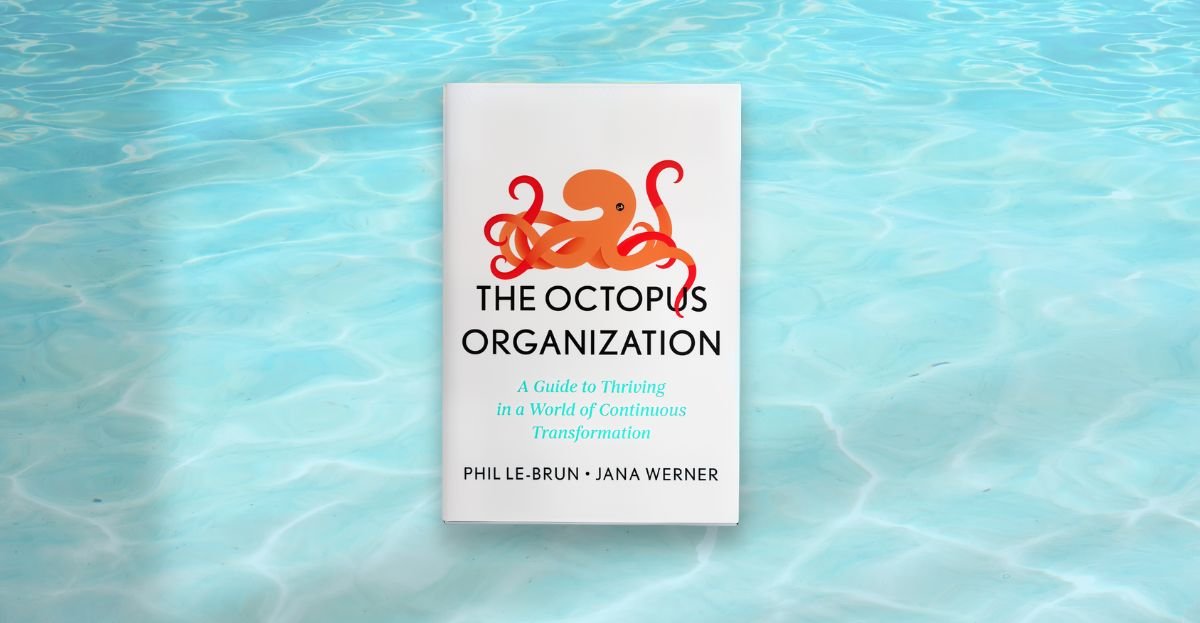


Book Review: The Octopus Organization
A Guide to Thriving in a World of Continuous Transformation
In today’s workplace reality, change is no longer a phase organisations prepare for – it is the environment they operate in every day. Business models evolve faster than job descriptions, leadership playbooks expire quickly, and people decisions increasingly shape organisational resilience.
The Octopus Organization enters this conversation with a sharp provocation: organisations designed for control will struggle in a world that rewards adaptability. Instead of reinforcing rigid hierarchies, the book argues for organisations that behave more like living systems – responsive, intelligent, and capable of acting simultaneously at multiple points.
The metaphor it chooses is deliberate and powerful: the octopus.
The Central Metaphor: Why the Octopus Works
Unlike traditional organisations that rely on a single decision-making centre, an octopus operates through distributed intelligence. Each limb can sense, decide, and act independently while still remaining aligned to a shared purpose.
Translated into organisational design, this means:
- Decision-making moves closer to where work actually happens
- Teams are trusted with judgment, not just execution
- Speed and relevance matter more than procedural perfection
- Resilience is embedded into everyday operations
The book makes a convincing case that centralised command structures – while efficient in stable environments – become liabilities in conditions of continuous transformation.
This thinking is echoed in a recent Harvard Business Review article, “Become an Octopus Organization,” which reinforces the same central argument: organisations built for speed and learning must decentralise authority while strengthening shared purpose. The article underlines that adaptability does not come from loosening discipline, but from replacing rigid control with clear intent, cultural coherence, and trust in local decision-making – principles that sit at the heart of the octopus metaphor.
Leadership Reimagined: From Authority to Alignment
One of the book’s strongest contributions lies in how it reframes leadership. Leadership in an octopus-like organisation is not about visibility, approval layers, or constant oversight. It is about alignment.
Leaders are expected to:
- Provide clarity of intent rather than micromanaged instructions
- Build shared principles that guide autonomous decisions
- Enable coordination across teams without slowing them down
This shift requires leaders to redefine their value – from being decision-makers-in-chief to designers of context. The book is refreshingly honest about how difficult this transition can be, especially for leaders shaped by traditional hierarchy.
Culture as Infrastructure, Not Initiative
A recurring insight throughout The Octopus Organization is that decentralisation without cultural clarity leads to confusion, not agility. Autonomy only works when people share a deep understanding of purpose, expectations, and boundaries.
The book positions culture as organisational infrastructure – largely invisible, but critical to performance. When principles are clear, fewer rules are required. When trust exists, speed follows naturally.
Related Posts
This perspective aligns strongly with what we consistently observe at Amazing Workplaces®: organisations with high trust and cultural clarity outperform not because they control people better, but because they enable better decisions.
What the Book Does Particularly Well
- Treats transformation as ongoing: Change is presented as a permanent condition, not a time-bound initiative.
- Respects human judgment: Employees are viewed as thinking contributors, not risks to be managed.
- Challenges structural orthodoxy: The book questions long-standing assumptions about hierarchy, authority, and control.
Where Organisations May Pause
For organisations deeply embedded in command-and-control systems, the ideas may feel confronting. Becoming an octopus-like organisation is not a matter of restructuring alone – it demands a leadership mindset shift, strong trust foundations, and consistency between stated values and lived behaviour.
Without psychological safety and leadership credibility, decentralised models can fragment quickly. The book does not oversimplify this risk, but it does expect readers to confront it honestly.
Why This Book Matters for Today’s Workplaces
For HR leaders, people managers, founders, and transformation teams, The Octopus Organization offers a useful lens to re-examine how work is designed and decisions are distributed.
At Amazing Workplaces®, where we assess organisations across culture, leadership, engagement, and trust, the book’s ideas closely mirror what certified workplaces demonstrate in practice: adaptability is not driven by policies – it is driven by empowered people operating within clear cultural frameworks.
Final Perspective
The Octopus Organization is not a tactical manual. It is a strategic wake-up call.
It challenges leaders to move away from excessive control and towards collective intelligence. In a world where transformation is constant and uncertainty is normal, organisations that can think, decide, and act in parallel will be the ones that endure.
For leaders looking to rethink organisational design, leadership alignment, and adaptability in an era of constant change, The Octopus Organization is a timely and worthwhile read. You can explore the book here.