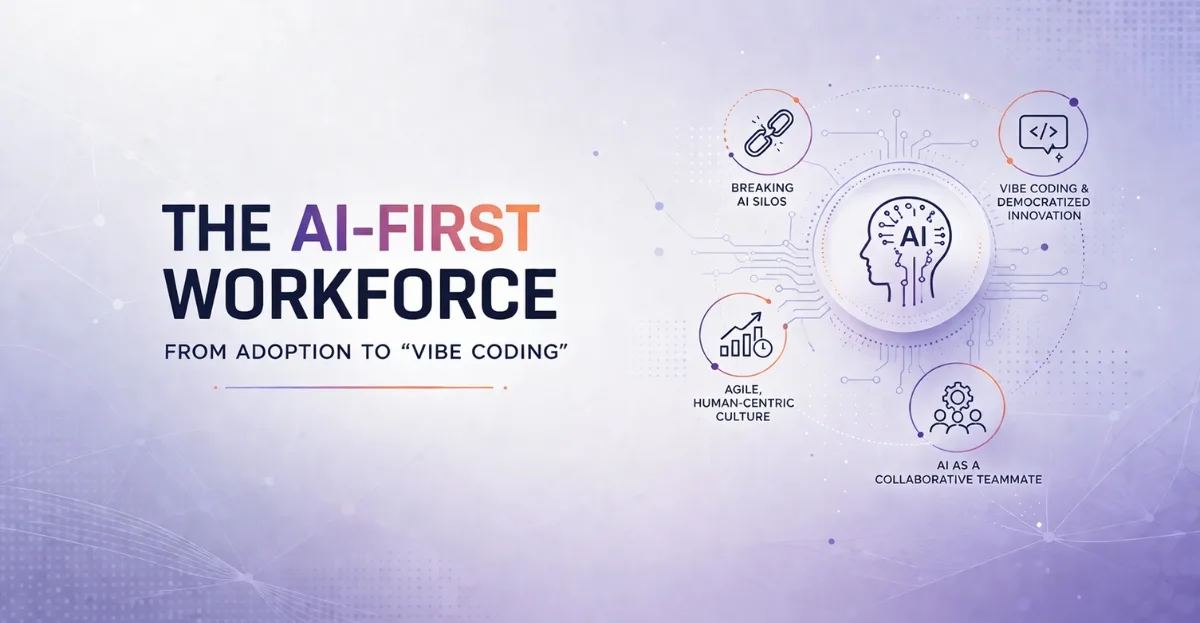
The modern workplace is going through a paradigm shift, where it is transitioning from just executing digital tools to reach a condition of technological fluency within organisational settings. Previously, the key technological shifts were being managed by consolidated departments, creating a gap between what the tool is able to accomplish and its practical application. The AI-first workforce represents the transition of artificial intelligence serving as a secondary software solution to acting as a key teammate.
At the centre of this major transformation lies inclusive innovation that allows every employee, irrespective of their technical backgrounds, to craft their own digital environment through methods such as ‘Vibe Coding’.
In other words, the AI-first workforce has evolved at a rapid pace from the simple adoption of generative AI tools for productivity purposes to a highly autonomous development and conversational paradigm termed ‘vibe coding’. The term ‘Vibe Coding’ was formulated by former Tesla AI and OpenAI leader Andrej Karpathy in February 2025. It is referred to as moving beyond line-by-line programming towards training and calibrating AI agents with natural language, where the user focuses on the intention or ‘vibe’ of the software, rather than the syntax.
Moving Past Departmental AI Silos
For several years, the way advanced technology was adopted followed a very predictable pattern, such as the IT department coming up with a solution, and then training the rest of the organisation on the method to use it. This resulted in ‘AI silos’, with the concentration of power and knowledge in the hands of a few people. Though this ensured security, it often disrupted the creative potential of the broader workforce. An organisation that is built on the foundation of an AI-first workforce breaks this compartmentalisation by integrating intelligence within every layer of the organisation. When AI becomes a total organisational embrace, the technology turns into a foundational aspect of the entire employee experience. This change is necessary for shaping a culture of agility, where the gap between identifying a problem and employing a solution is lowered within minutes instead of months.
The Concept of Vibe Coding and Democratized Innovation
The concept of ‘Vibe Coding’ has brought in a revolution in the universalisation of workplace technology, referring to a transition in the way humans interact and engage with machines – moving beyond complicated programming languages and rigid syntax towards intent/vibe-based creation and natural language. In the AI-first workforce, employees are empowered by Vibe-Coding to form their own agentic AI assistants through simple communication of ‘logic’, ‘vibe’, and the desired outcome of a task.
This equalisation makes certain that innovation is not just a hierarchical mandate but a natural movement. When a human resources professional can ‘vibe code’ an assistant to oversee complex sentiment analysis or scheduling without waiting for an initiative by the developer, the whole organisation gets momentum. This results in greater levels of employee engagement, since employees are no longer just passive users of technology, but actively building their own productivity.
AI Turning Into A Teammate From Being Just Treated As A Tool
One of the most noteworthy changes in the modern workplace is the shift of AI from acting as a static tool to becoming a potent teammate. A teammate, specifically an agentic AI assistant, can help in the identification of goals or objectives and execute multi-stage processes in an independent way, whereas a tool requires perpetual manual input.
In an AI-first workforce, these digital teammates manage the repetitive and high-volume tasks that often lead to employee burnout. As per research by Gartner, organisations focusing on or emphasising human-centric AI witness a huge rise in intent to stay and greater levels of choice-based efforts from their employees. By delegating ‘drudge work’ to AI teammates, the human workforce becomes free to focus on the work elements that are not replaceable by machines, such as ethical judgment, empathy, strategic thinking, complex interpersonal partnerships, or collaboration.
The Cultural Impact Of the AI-First Workforce
The transformation to an AI-first workforce is both a cultural and a technical barrier, since it necessitates an integral reconceptualisation of leadership and organisational behaviour. Leaders must be moving beyond just having control over information towards the enablement of access. This leads to a workplace environment that is defined by high-trust levels as well as accountability.
When employees are trained in Vibe Coding and are encouraged to devise their own tools, it signifies a considerable investment in their professional growth and career. It brings a transformation in the workforce into a group of problem-solvers instead of just those who execute tasks. This sense is a foundation of psychological safety, where employees get the feeling that they possess the tools for navigating a landscape that is changing rapidly. This will lead them to embrace change more likely rather than avoiding it. As studies from Harvard Business Review have highlighted, the digital transformations that are highly successful are those that place continuous learning and employee adaptability over the technology that is used.
Steps to Take For a Total AI-Powered Organisational Embrace
Reaching a state where AI acts as a universal teammate needs a structured approach for learning and development (L&D). Organisations must be moving past custom training sessions towards a constant ‘learning -in-the-midst-of-the-flow-of-work’ model.
Some of the steps to take for an organisational embrace are as follows:
- Each and every employee, starting from the C-suite level to the entry level associate should be knowing and understanding agentic AI basics and the way to express intent.
- All the departments must be encouraged to identify their own resistance points and utilise Vibe Coding for building localised solutions.
- Internal forums should be devised where employees can share details about the agents they have formed, encouraging a community based on peer-to-peer learning.
- The AI Native Transformation Index (ANTI) should be utilised within organisational settings. It is a proprietary metric continually assessing its AI maturity and is a core pillar of its formal business plan, treating digital transformation as a measurable financial objective rather than a vague goal.
- A true “Owner’s Mindset” should be fostered by aligning the organisational business plan directly with employee rewards. Upon achieving key performance indicators (KPIs), profits should be shared with the entire workforce, ensuring that when the company wins, every individual sees the direct impact on their own success.
- Teamwork is a core value reinforced by intentional social architecture. “KYC” (Know Your Colleague) Lunches should be hosted to break down cross-functional silos, supported by a dedicated quarterly budget for team outings, allowing departments to bond and reach their own terms.
- Traditional time monitoring should be excluded in favor of an entirely Result-Oriented Work Environment. According to a 2024 Gartner study, around 41% of the employees had the feeling that they were not trusted enough after the introduction of monitoring tools by their company and about 38% reported that the move had affected their motivation to do work (https://amazingworkplaces.co/employee-monitoring-software-workplace-surveillance-trust-risk/). By offering unlimited leave, organisations shift the focus from “hours clocked” to “value delivered,” placing a high premium on the professional maturity and autonomy of the employees.
- To ensure leadership remains accessible, a Weekly Management Slot system should be utilised where any employee can book a time with the senior leaders. These sessions are kept as stringently confidential for the management but carry a directive for rapid, formal, and documented action.
Conclusion: Shaping the Workplace of Tomorrow With Vibe Coding
The journey from basic AI adoption to an AI-first workforce that is fully realised is the main challenge for HR leaders in the upcoming years. By adopting ‘Vibe Coding’ and nurturing a culture where AI is looked at as a teammate, organisations can realise absolute levels of employee satisfaction and innovation. This is not just surrounding human talent replacement, but about enhancing it.
In a well-defined workplace, technology enables the human experience and not vice-versa. When every individual is empowered to construct their own digital support systems, we result in a workplace that is faster, more diverse, and more humane. The future of work is not shaped by just writing code, it is experienced in the ‘vibe’ of a groundbreaking, empowered, AI-competent community.