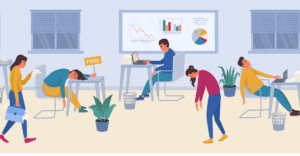
Picture a product review call with people dialed in from Bengaluru, Dubai, Frankfurt and Chicago. One engineer has spotted a flaw in the plan. She builds the sentence in her head, rewrites it twice, and by the time she’s ready, the conversation has moved on. The point never gets made.
Nobody logs that moment anywhere. But second-language anxiety at work produces it every day, in every company that runs meetings in a language most of its people didn’t grow up speaking.
What is second-language anxiety at work?
Second-language anxiety at work is the worry, tension and self-consciousness people feel when they have to speak or write in a language that isn’t their first, in a professional setting. It shows up as silence, over-preparing, simplified answers, or letting a colleague speak for them, even when the person knows the subject well.
Researchers have studied the broader idea, usually called foreign language anxiety, for decades. A review in the Annual Review of Applied Linguistics covers its causes and effects. The classroom version is well documented. The workplace version is where it gets expensive, because the stakes are a promotion, a client, or a decision made without your input.
What the data says about silence in global teams
A 2026 survey by the language-learning company Busuu asked more than 1,000 of its workplace learners across 64 countries about this. The results are hard to ignore:
- 55% simplify what they want to say when using a second language at work.
- 25% stay silent even though they have something useful to add.
- Another 25% let a colleague speak on their behalf.
- 90% prepare before high-stakes conversations, mostly by writing scripts or using translation apps.
One caveat. These respondents are people already using a language app, so they aren’t a random sample of the workforce. Treat the percentages as a signal, not a global average. The pattern itself matches older findings. Pamela Rogerson-Revell’s 2008 study of international business meetings found that native speakers didn’t dominate airtime. What stood out was how many non-native speakers were present the whole time and contributed nothing.
Unplanned moments hurt most. In the Busuu survey, 49% said unexpected conversations create the most anxiety in a normal week, ahead of scheduled international team calls at 26%. That fits what most people already suspect: a rehearsed update is manageable, and a surprise question from a senior leader is not.
Why capable people go quiet
Fluency isn’t the issue. Plenty of people who stay silent in meetings are articulate in writing and sharp in one-to-one chats.
Part of it is mental load. Speaking a second language means finding words, building grammar and watching how you sound, all while still thinking about the actual idea. Anxiety adds to that load, which makes the sentence harder, which adds more anxiety.
The other part is social. Amy Edmondson’s 1999 paper on team learning defined psychological safety as a shared belief that the team is safe for interpersonal risk-taking. For someone speaking their second language, every contribution carries a small extra risk: sounding clumsy in front of a senior person. When that risk feels bigger than the cost of keeping quiet, silence wins. A vague reputation for “being quiet” is a much smaller price than one awkward sentence heard by forty people.
In many Indian workplaces, English is the working language but not the first language of most people in the room. Add colleagues in Dubai or London who speak it natively and fast, and the gap widens.
How managers misread the silence
Silence rarely looks like anxiety from the outside. It looks like disinterest. Or low confidence. Or a lack of ideas.
That misreading does the real damage. The quiet person gets fewer stretch assignments, because they “don’t speak up.” Leaders see the same few voices and assume those voices represent the team. A language barrier gets recorded as a personality trait, and then as a performance rating.
A simple check: track who speaks, and for how long, across three consecutive meetings. If the silent people are consistently the ones working in their second language, you’re looking at a pattern, not a personality mix.
Signs it’s happening on your team
- Someone writes sharp, detailed emails but says little on calls.
- A colleague routinely lets another person “summarise” for them.
- People apologise for their English before every contribution.
- Good ideas surface in private messages after the meeting, not during it.
What leaders can do about it
None of this needs a new budget. Most of it is meeting hygiene.
Related Posts
Share the agenda and key questions in advance: Written prep helps anyone working in a second language, because reading is self-paced and listening isn’t. Even a day’s notice changes who can contribute.
Let silence last longer: Most facilitators fill a pause within a second or two. Try waiting five. Someone is usually assembling a sentence.
Open a written channel: Invite people to add thoughts in the chat or a shared document first, then read them out or discuss them. The idea gets into the room without requiring a live performance.
Correct less: In meetings, ask for clarification instead of fixing someone’s grammar. If a person tries to speak your language, stay in that language unless they ask you to switch.
Use captions and transcripts: A review by Morton Ann Gernsbacher covering more than 100 studies found captions improve comprehension and memory, with the biggest benefit for people watching in a non-native language. Turning them on costs nothing.
Say it out loud yourself: When a senior leader admits they’ve struggled in a second language, the rest of the room relaxes. It’s the cheapest psychological safety tool there is.
How to find out if it’s a problem in your company
You can’t fix what you can’t see, and people won’t volunteer this in an open forum. Ask anonymously. Add statements to your pulse survey such as “I can disagree with a senior colleague in meetings in the language we use” or “I share my ideas in meetings as often as I want to,” and compare results by team, location and tenure.
At Amazing Workplaces, our employee engagement surveys and workplace certification programme has collected responses from over 60,000 employees, and one thing holds steady: scores on “being heard” and “speaking up” tell you more about culture than headline satisfaction numbers do. If you want to read more on how people practices shape retention and engagement, our HR blog has more.
What employees can do right now
If you’re the one staying quiet, a few small habits help:
- Ask for the agenda early and prepare your first sentence, since starting is the hardest part.
- Use the chat to get your point in, then speak to it once someone picks it up.
- Say “let me rephrase that” instead of apologising. It sounds like a speaker taking control, not one losing it.
- Tell one trusted colleague. You’ll probably find they’ve felt the same.
FAQs
Is second-language anxiety the same as poor language skills?
No. Many people with strong vocabulary and grammar still freeze in high-pressure meetings. The anxiety is about being judged while speaking, not about what they know.
Why do employees stay silent in global teams even when they have good ideas?
Speaking a second language takes extra mental effort, and sounding imperfect in front of seniors feels risky. Staying quiet feels safer than a mistake that others might remember.
How can managers reduce language anxiety in meetings?
Share agendas ahead of time, allow longer pauses, invite written input first, avoid correcting grammar in public, and use captions or transcripts.
Can language anxiety hurt careers?
It can. When someone’s ideas never reach the room, they’re less visible, and visibility often shapes who gets opportunities.
The engineer from the opening call probably had the best idea in the meeting. Your team likely has someone like her. The fix isn’t a language course. It’s making the room safe enough that she says it before the conversation moves on.