If you’ve been wondering whether your company is ready for a workplace certification – or whether the whole process is just a checkbox exercise – this guide is for you.
More Indian HR leaders are pursuing workplace certification not because it looks good on a LinkedIn post (though it does), but because the assessment process itself forces an honest conversation about what employees actually think. That tends to surface uncomfortable truths. And then you fix them. That’s the whole point.
This guide walks through the certification process at Amazing Workplaces® – one of India’s most recognized workplace certification platforms – from the moment you decide to apply, to what happens after you earn the badge.
1. What Workplace Certification Actually Means in India
Workplace certification in India is not a government-issued license or a statutory requirement. It’s a voluntary recognition that an independent platform awards to organizations after evaluating their people practices – typically through employee engagement surveys, culture audits, or both.
The reason companies pursue it comes down to three things. First, talent: when candidates compare two job offers, certification signals that employees have independently rated the workplace well. Second, culture data: the assessment produces benchmark data that most HR teams don’t otherwise have access to. Third, employer brand visibility – certified organizations get featured on the platform’s media and search presence, which reaches job seekers actively looking.
In India’s market, where attrition in sectors like IT, BFSI, and FMCG runs persistently high, being able to point to third-party validation of your culture carries more weight than a careers page with stock photos.
Note: Workplace certification is different from ISO certifications or Bureau of Indian Standards compliance. It is not a legal requirement – it is a recognition of people management quality, evaluated against a structured framework.
2. Who Can Apply – and Who Isn’t Ready Yet
The eligibility bar is deliberately low, because the certification is as much about the improvement process as the outcome. At Amazing Workplaces®, the requirements are: your organization must be legally registered, operational for at least one year, and have a minimum of ten full-time employees on payroll.
That’s it. Whether you’re a 12-person startup in Pune, a 400-person manufacturer in Coimbatore, or a 5,000-employee enterprise in Gurugram, you’re eligible. Certified organizations are categorized by employee strength, so a startup is never benchmarked against a large enterprise.
Signs you’re ready to apply
- Your leadership is genuinely open to hearing what employees think – not just what managers report upward
- You have at least some baseline HR policies documented (compensation, leave, onboarding)
- You can encourage employee participation in a confidential survey without it feeling like a threat
- Someone owns the process – an HR lead or a founder willing to drive it
Signs you might want to wait
- You’ve had major layoffs in the past three months and morale is openly fractured
- You don’t have stable HR processes in place, even basic ones
- The leadership team sees this as a PR move rather than a diagnostic tool
Honest take: Organizations that apply hoping to pass without examining their gaps tend to score below 70%. The ones that treat the assessment as a mirror, not a trophy, get the most out of it either way.
3. The Three Workplace Assessment Tracks
Amazing Workplaces® offers three distinct programs. Choosing the right one depends on what you’re trying to learn and who you want to hear from.
Amazing Workplaces® Culture Audit & Certification (HR-led)
Your HR team fills out a structured questionnaire designed to measure the maturity and effectiveness of your people practices, mapped to the 9-pillar framework. Organizations scoring 70% and above earn the certification. Best for teams that want to benchmark their HR infrastructure before opening it up to employee feedback.
Survey & Certification (Employee-led)
The flagship program. All employees complete a confidential survey assessing their experience across all 9 pillars. Only aggregated data is shared with leadership – individual responses are never disclosed. Organizations with a 70%+ average score are certified. Best for organizations ready to hear honest, unfiltered employee feedback.
Customized Surveys
For organizations with a specific culture question to answer – DEI sentiment, hybrid work effectiveness, leadership pulse, or engagement in a particular function. Fully tailored to your goals with expert consultation.
Most first-time applicants choose either the Amazing Workplaces® Culture Audit or the Employee Experience Survey & Certification. The audit is faster and HR-controlled. The survey is slower and more revealing, because it captures what employees actually experience, not what policy documents say should happen.
4. The 9-Pillar Framework Explained
Every assessment – regardless of which track you choose – is evaluated against the Amazing Workplaces® 9-Pillar Framework. These pillars represent the components that, together, define the quality of a workplace:
- Culture
- Hiring & Retention
- Employee Engagement
- Rewards & Recognition
- Internal Communication
- Diversity, Equity & Inclusion (DEI)
- Learning & Development
- Corporate Social Responsibility (CSR)
- Employee Experience
Each pillar carries its own weight in the overall score. Culture and engagement tend to show the widest variance between organizations – they’re also where the most meaningful improvements happen post-assessment.
5. Step-by-Step: The Application Process
Step 1: Register on the Amazing Workplaces® platform
Go to amazingworkplaces.co and fill out the registration form. You’ll select the program you’re applying for, confirm your organization has been operational for over a year, and confirm you have 10+ full-time employees. The form also asks how you heard about the platform.
Step 2: Get onboarded by the team
After registration, the Amazing Workplaces® team reaches out to walk you through the process. This is the right time to ask questions about the timeline, what the survey involves, and how to communicate the process internally. Clarity here saves confusion later.
Step 3: Prepare your internal communication
Before the survey goes live, communicate the purpose to your employees clearly and honestly. Participation rates matter – a survey with low participation produces unreliable data. Employees need to know the survey is genuinely confidential and that individual responses will never be traced back to them. To make this easier, Amazing Workplaces® provides a pre-designed set of professionally designed collaterals to help you communicate about the survey effectively.
First-timer tip: The biggest bottleneck in most certification journeys is internal communication before the survey launches. Organizations that brief their employees well – explaining why they’re doing this, what happens with the data, and why participation matters – get higher response rates and more reliable results.
Step 4: Complete the assessment
For the Employee Experience Survey & Certification track, employees complete an online survey covering all 9 pillars. Only aggregated data is shared with leadership. For the Amazing Workplaces® Culture Audit, the HR team fills out a structured questionnaire mapping your current practices against the framework. Neither process is onerous, but set aside adequate time.
Related Posts
Step 5: Receive your results and report
After the survey closes and data is analyzed, you receive a detailed report showing your scores across all 9 pillars, your overall average, and where you stand relative to benchmarks. This report is a powerful tool regardless of where you score – it gives you clear, actionable insights into what your organization is doing well and where the biggest opportunities for growth lie.
Step 6: Get certified (if you score 70% or above)
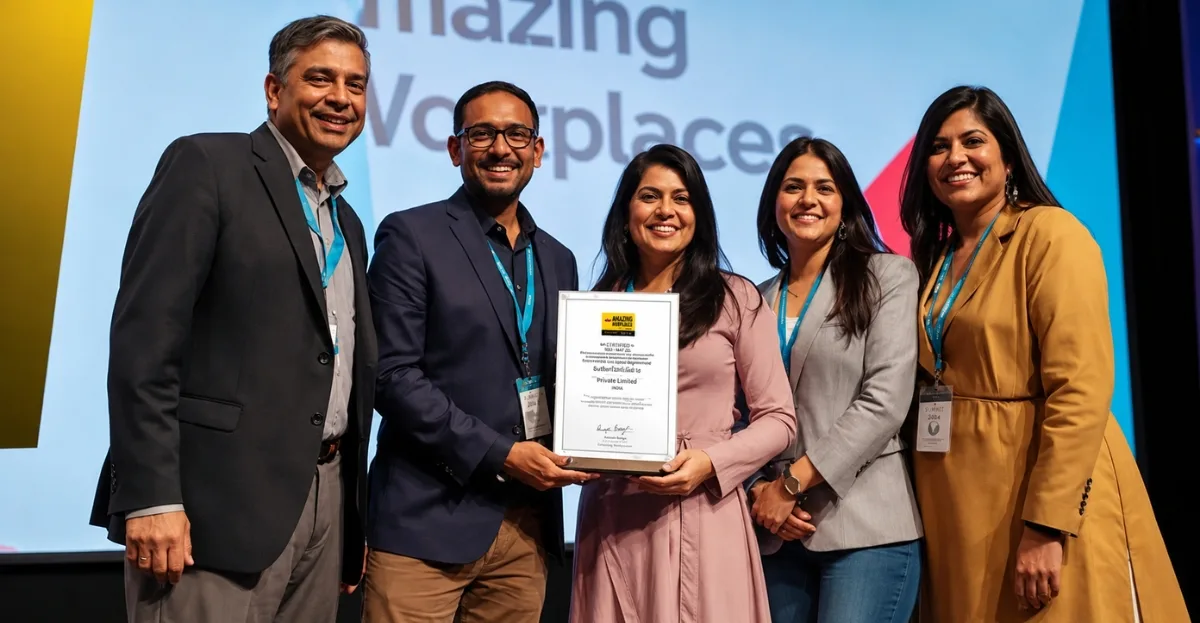
Organizations that achieve an average score of 70% or higher are certified as Amazing Workplaces®. You receive the certification badge, recognition on the platform, and access to media features that strengthen your employer brand.
Step 7: Use the certification and act on the findings
Display the badge, share the recognition, and then – more importantly – build an action plan around the pillar scores that came in below your expectations. Organizations that treat certification as a one-time event don’t get much lasting value from it.
6. How Scoring Works and What 70% Actually Means
The scoring threshold is 70% across the 9 pillars. Individual pillar scores can vary – an organization might score 85% on culture and 62% on learning and development – but the aggregate average needs to clear 70%.
What does 70% mean in practice? It means the majority of your employees consistently rate your workplace positively across the key dimensions of their experience. Organizations that have invested in decent HR practices, communicate openly, and take employee wellbeing seriously tend to clear it.
Organizations that fall short often do so in predictable ways: compensation and benefits scoring low where market alignment hasn’t been reviewed in a while; DEI scores suffering where policies exist on paper but haven’t been operationalized; internal communication scores falling in companies where leadership decisions are communicated very late.
What happens if you don’t reach 70%?
You don’t get the certification badge, but you do get the full assessment report – which is often more valuable than the badge itself. It shows you, by pillar, exactly where the friction is. Many organizations treat a below-threshold first attempt as the foundation for a more deliberate second attempt six to twelve months later. That’s not failure. That’s the intended path.
7. After Certification: What You Get and What to Do With It
What you receive
- The Amazing Workplaces® certification badge for use on your careers page, LinkedIn, job listings, and email signatures
- Coverage and recognition on the Amazing Workplaces® platform, actively used by HR professionals and job seekers across India
- Size-category recognition (10–49, 50–149, 150–249, 250–999, 1000+) so you’re benchmarked against peers at your scale
- Pillar score data – areas of strength and gaps to address
How to get lasting value from it
The organizations that extract real value from certification treat it as an annual culture audit rather than a marketing exercise. They share results transparently with employees – not just the good scores, but the ones that need work. They build a concrete action plan, assign ownership for each improvement area, and apply for recertification the following year.
On the employer branding side, in India’s competitive talent market, a credible third-party signal that your employees rate you well carries more weight with candidates than self-promotional job postings. Recruiting teams that integrate certification into their hiring narrative – as evidence they can speak to, not just a badge on a banner – tend to see better candidate quality and shorter time-to-fill.
Tip: Don’t just put the badge on your careers page. Ask employees to share what the certification process meant to them – short quotes on LinkedIn, a feature in your company newsletter. Peer voices carry more credibility than marketing copy.
8. Common Questions From First-Time Applicants
Is the survey free?
No. The assessment is a paid program. Pricing depends on the track you choose and your organization’s size. The Amazing Workplaces® team will walk you through specifics during onboarding.
How long does the process take?
From registration to receiving your results, most organizations complete the process within four to eight weeks. The biggest variable is how quickly employees participate in the survey window.
Will employees know what their responses are used for?
The survey is fully confidential. Only aggregated data is shared with your leadership team. Individual responses are never attributed or disclosed – that’s what makes honest feedback possible.
Can a startup or MSME apply, or is this only for large companies?
Any legally registered organization with at least one year of operation and 10+ full-time employees is eligible. The platform actively certifies startups, MSMEs, and enterprises, with separate benchmarks for each size bracket.
What if we score below 70% on some pillars but above on others?
What matters for certification is the average across all pillars. But the pillar breakdown is where the real learning happens. A 62% on DEI with an 88% on culture tells you something very specific about where to focus over the next year.
Does certification expire?
Yes. Workplace certification is valid for a defined period. Most organizations reapply annually or biennially – which is by design, since the goal is continuous improvement, not a one-time achievement.
The Honest Reason This Is Worth Doing
Workplace certification in India has occasionally been dismissed as a vanity metric. That criticism is fair when organizations treat it that way – applying once, slapping a badge on the careers page, and moving on.
But the underlying mechanism is sound. An anonymized employee survey, scored against a structured framework, gives you data that’s much harder to get through internal feedback channels. People say different things when they know it’s confidential and managed by a third party. The gaps that show up are the ones your managers may have been softening, or that leadership simply hasn’t heard yet.
The organizations that take workplace certification seriously – and use it as one input in a broader culture improvement effort – tend to see measurable effects on retention, candidate quality, and employee engagement over a two-to-three year period. Not because the badge works magic. Because the assessment made the invisible visible, and they did something about it.
If you’re a first-time applicant, start with honest expectations: apply because you want to understand where you stand, not just because you want to say you’re certified. The certification will follow if the first part is done well.
To apply for Amazing Workplaces® Certification, visit: amazingworkplaces.co/amazing-workplaces-survey-certification-registration