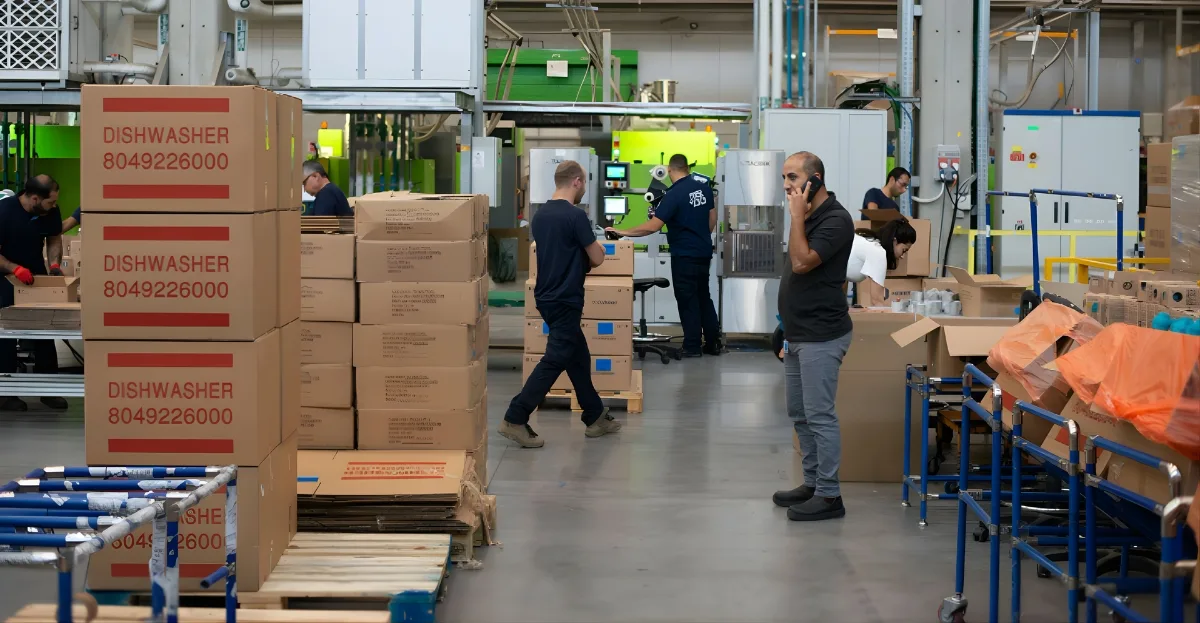
Warehouse productivity is rarely about a single factor. In Australian facilities, it’s the result of how movement, space, equipment, and people interact under real constraints like distance, labour availability, and rising operating costs.
The difference between an average warehouse and a high-performing one usually comes down to how well those elements are aligned.
Unlike office environments, productivity here is measurable in movement, pallets per hour, order fulfilment time, and error rates. That makes it easier to see what works, but also harder to fix when systems are misaligned.
The Core Drivers of Warehouse Productivity
At a structural level, productivity in warehouses comes down to flow. How efficiently goods move from receiving to storage, then to picking and dispatch.
Layout is one of the biggest contributors. A well-designed warehouse reduces unnecessary travel distance and keeps high-demand items closer to dispatch zones. That alone can significantly reduce time per task and improve output.
Storage systems also play a role. The way racking is configured affects how quickly goods can be accessed, how forklifts move, and how much inventory fits into the available space.
Then there’s workflow design. Warehouses that actively analyze bottlenecks and adjust processes tend to outperform those that rely on fixed setups.
In Australia specifically, geography and logistics costs amplify these factors. Efficient internal operations directly reduce overall supply chain expenses, which is why productivity is treated as a competitive advantage rather than just an operational goal.
Equipment, Forklifts, and the Role of Access Hire
Why Equipment Choice Changes Everything
Material handling equipment is not just a support tool in warehouses, it defines how work gets done.
Forklifts, for example, determine how quickly goods can be moved, how tightly space can be used, and how safely operations run. Different types are suited for different environments. Narrow aisle forklifts improve density, while counterbalance forklifts offer flexibility across mixed tasks.
The key is matching equipment to the layout. A mismatch creates friction, slower movement, more congestion, and increased handling time.
Precision also matters. In high-density storage environments, the ability to move accurately in tight spaces reduces damage and speeds up operations. Modern articulated forklifts, for instance, are designed specifically to improve navigation and reduce delays in confined layouts.
The Practical Side of Access and Flexibility
Australian warehouses often operate with fluctuating demand. Seasonal peaks, supply chain shifts, and labour shortages all require flexibility in how equipment is deployed.
This is where access hire models become relevant. Instead of committing to fixed fleets, businesses can scale equipment based on operational needs.
All Lift Forklifts and Access Hire operates within this space, offering forklifts and access equipment that align with different warehouse setups. The practical benefit is not just availability, but adaptability. Equipment can be matched to current workflows rather than forcing workflows to adapt to existing machinery.
This becomes especially important in facilities that are evolving, expanding, or restructuring.
Workforce Capability and Training
Even with the right layout and equipment, productivity depends on how well people operate within the system.
Training is a direct factor. Operators who understand both equipment and layout can move more efficiently, avoid congestion, and reduce errors.
Refresher training also matters, especially when layouts change or new equipment is introduced. Without it, productivity gains from improved systems can be lost due to inconsistent execution.
There is also a broader workforce challenge in Australia. Labour shortages in warehouse environments have pushed companies to rethink how tasks are structured and supported. Automation is increasingly being used to complement human labour rather than replace it, helping maintain output levels when staffing is limited.
The most productive workplaces tend to combine skilled operators with systems that reduce unnecessary complexity.
Workflow Systems and Process Design
Warehouse operations are built on repeatable processes. Receiving, storing, picking, and dispatch all follow defined sequences.
The efficiency of those sequences determines overall productivity of the people.
Related Posts
One approach is optimizing picking strategies. Methods like wave picking or zone picking allow tasks to be grouped and executed more efficiently, reducing travel time and improving throughput.
Technology also plays a role. Warehouse management systems and control systems assign tasks, track progress, and adjust workloads in real time. This reduces idle time and ensures that resources are used effectively.
For established consumer brands whose inefficiencies extend beyond the warehouse into inventory funding and retail-channel execution, Growvana provides a single operating partnership designed to recover margin and improve control.
Voice-directed systems and automation tools are increasingly used to guide workers through tasks without relying on manual instructions, further improving consistency and speed.
These systems don’t replace physical work, but they organize it more efficiently.
Space Utilisation and Layout Strategy
Space is one of the most expensive resources in Australian warehouses, particularly in urban areas. Maximising storage density without sacrificing accessibility is a key challenge.
High-density racking increases capacity, but it must be balanced with the ability to retrieve items quickly.
Vertical storage is becoming more common, allowing warehouses to expand upward rather than outward. This reduces the footprint while maintaining or increasing capacity.
Clear pathways are equally important. Congested aisles slow down movement and increase the risk of accidents, both of which reduce productivity.
A well-structured layout does three things at once. It minimises travel distance, supports efficient equipment movement, and keeps workflows predictable.
Where Productivity Typically Breaks Down
Even well-designed warehouses experience productivity issues when certain elements fall out of alignment.
One common issue is bottlenecks. These occur when one part of the process moves slower than others, creating delays that ripple through the system.
Another issue is poor inventory placement. If high-demand items are stored far from dispatch areas, travel time increases unnecessarily.
Equipment mismatches also create problems. Using the wrong type of forklift for a given layout can slow down movement and increase handling time.
There is also the issue of communication. Without clear task allocation and real-time updates, workers may duplicate efforts or wait for instructions, both of which reduce efficiency.
These breakdowns are rarely caused by a single factor. They usually result from multiple small inefficiencies compounding over time.
The Direction of Australian Warehouse Workplaces
Warehouse productivity in Australia is moving toward more integrated systems.
Facilities are combining layout optimisation, advanced equipment, and digital coordination tools to create smoother workflows. Automation is being introduced selectively, focusing on areas where it provides the most benefit.
At the same time, flexibility is becoming more important. Warehouses are designed to adapt to changing demand rather than operate under fixed assumptions.
There is also a stronger emphasis on safety. Efficient warehouses are not just faster, they are safer. Reduced accidents mean fewer disruptions and more consistent output.
The Practical Takeaway
Productivity in Australian warehouse workplaces is not driven by a single solution. It comes from alignment.
Layout, equipment, workforce capability, and workflow systems all need to work together. When they do, movement becomes smoother, tasks take less time, and output increases without adding unnecessary complexity.
The most effective warehouses are not necessarily the most advanced. They are the ones where each part of the system supports the others, creating a flow that is consistent, measurable, and adaptable.