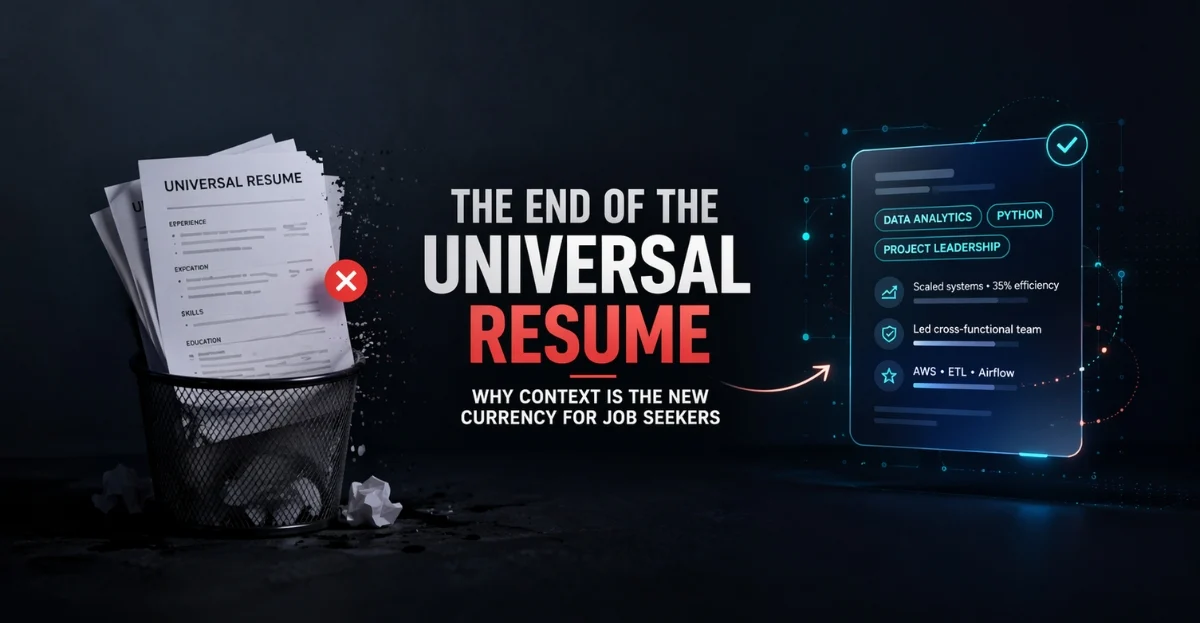
The era of the “master resume”- that polished, static document sitting in a folder named “Final_Version_2026” – is officially over. For decades, job seekers were taught to build a single, comprehensive record of their professional lives and blast it out to every open vacancy that looked remotely interesting. It was a game of volume. If you sent enough copies of your one-size-fits-all document, the law of averages would eventually land you an interview.
In the modern job market, the law of averages has been replaced by the precision of algorithms. Today, the universal resume isn’t just ineffective; it is a liability. As companies increasingly rely on sophisticated search systems and human recruiters who have mere seconds to scan a profile, the generalist approach is the fastest way to land in the digital trash bin. The new gold standard isn’t just experience – it is context.
The Job Title Trap: Same Name, Different DNA
The disconnect begins with the job title. In the past, a title like “Marketing Manager” or “Software Engineer” meant roughly the same thing regardless of the industry. That is no longer the case. In 2026, titles have become empty vessels. A Data Engineer at a fintech startup might spend their entire day managing distributed systems and streaming infrastructure, while a Data Engineer at a legacy retail corporation might be focused almost exclusively on ETL pipelines and dashboard maintenance.
On paper, they share a title. In reality, they perform entirely different professions. When a candidate uses a static resume, they are essentially asking the recruiter to do the heavy lifting of “translating” their experience to fit the specific needs of the company. In a high-volume hiring environment, no one has time for that translation. If the resume doesn’t immediately mirror the specific language, technical requirements, and implied expectations of the job posting, the system assumes the candidate is a mismatch. This is why highly qualified individuals often receive automated rejection letters within minutes of applying. They weren’t rejected because they lacked the skills; they were rejected because their skills were presented without the necessary context.
Decoding the Employer’s Dictionary
Every job description is essentially a unique dictionary created by the hiring team. It contains the specific vocabulary they use to describe success. To thrive in this environment, job seekers need an AI resume builder that treats every posting as its own language. The goal is no longer to be “the best candidate” in a general sense, but to be the exact answer to the specific problem described in the listing.
Effective alignment goes beyond simple keyword matching. It involves identifying not just the explicit requirements, such as “Python” or “Project Management,” but also the subtle cues that signal a company’s culture and priorities. For example, a job description that emphasizes “rapid iteration” and “cross-functional agility” requires a very different presentation than one that prioritizes “compliance,” “risk mitigation,” and “standard operating procedures.”
The challenge for job seekers is that manually decoding these nuances for fifty different applications is a recipe for burnout. It is a grueling, repetitive task that leads to errors and diminishing returns. This is where professional AI resume tailoring becomes a strategic necessity. By using a structured analysis of the job description, technology can now compare a user’s real-world experience against the specific requirements of a posting to highlight what matters most, ensuring the most relevant achievements move to the top of the pile.
The Recruiter’s Reality: Six Seconds to Relevance
Human recruiters are under immense pressure. Research consistently shows they spend less than seven seconds on a resume before deciding whether to move forward. In those few seconds, they aren’t looking for a list of everything you have ever done; they are looking for a signal that you understand their specific world.
If your resume is a wall of text covering fifteen years of broad experience, the recruiter has to hunt for that signal. A tailored document acts as a roadmap. It signals to the hiring team that you don’t just have the skills on paper, but you understand how those skills apply to the specific problems they are trying to solve. If a job posting mentions a need for “scaling infrastructure for millions of users,” a contextualized resume will emphasize your experience with load balancing and distributed databases rather than minor contributions to front-end design.
Related Posts
This approach also solves the “ATS Filter” problem. Most people view automated systems as gatekeepers designed to keep people out. In reality, they are search engines. When a recruiter searches for a specific skill set, the system ranks candidates based on how closely their work history matches those terms. A static resume might mention a tool in a skills list at the bottom, but a tailored resume weaves it into the narrative of previous roles, proving the candidate has applied that tool in a relevant scenario.
Moving Between Industries: The Translation Layer
One of the greatest benefits of focusing on context is the ability to transition between industries. A professional moving from healthcare to tech might have incredible project management skills, but they often struggle to explain how “patient data privacy compliance” translates to “SaaS data security standards.”
Modern tailoring tools act as a translation layer. They identify the core competencies within a candidate’s history and rewrite them using the industry-specific vocabulary of the target role. This isn’t about fabricating experience; it’s about ensuring the truth of your background isn’t lost because you used the “wrong” industry jargon. This level of precision is exactly what distinguishes a high-quality career platform from a generic template generator.
The 2026 Strategy: Quality Over Quantity
The digital age made it too easy to apply to hundreds of jobs with a single click, leading to a “noise” problem in recruitment. The future belongs to those who prioritize relevance over volume. Instead of applying to 100 jobs a day with a generic document, the top-performing candidates are applying to a handful of roles with unique, highly aligned resumes that speak the employer’s language fluently.
This shift toward context-driven hiring is a win for both sides. Companies receive highly relevant applications, which improves the efficiency of their hiring teams and strengthens their employer brand. Candidates, meanwhile, stop shouting into the void and start engaging in meaningful professional conversations.
Relevance is the Ultimate Competitive Advantage
The “universal resume” is a relic of a simpler, less competitive time. Today, your resume is not a historical record; it is a marketing document. Like any good marketing, it must be tailored to its audience. By shifting your focus from volume to context, you ensure your voice is heard above the digital din.
In a world where everyone has skills, the person who can prove their skills are relevant to the specific problem at hand is the one who gets hired. Context is the new currency—and it is time to start spending it wisely.